

Some museums show you art. Others reach across four decades and tap you on the shoulder. The Albertina does both — and on Day 6 in Vienna, it did something I wasn’t expecting: it sent me back to high school art class, where a teacher who didn’t understand geometric abstraction told me I was doing it wrong.
Spoiler: she was wrong. And Victor Vasarely, from beyond the grave, backed me up.
👁 Vista — The Albertina, in Two Acts
The Albertina is actually two museums — the grand main building on Albertinaplatz and Albertina Modern, a few blocks away on Karlsplatz. The €29.90 Kombiticket covers both, and it’s valid for a full year. I tackled the basement of Albertina Modern first, then crossed over to the main museum for the heavy hitters.
Albertina Modern Basement — Vasarely, Adrian, and a 40-Year Echo
The basement exhibition pairs two artists who shared an obsession with geometry and color: Victor Vasarely (the father of Op Art) and Marc Adrian (Austria’s own kinetic and constructivist pioneer). Vasarely’s grids of shifting squares and circles create optical illusions that vibrate as you stare at them. Adrian’s work is more austere — precise arrangements of colored rectangles that feel like jazz on a canvas.

And here’s where the time machine kicked in. In high school art class, I did projects just like these — geometric abstractions, color combinations, optical play. My art teacher didn’t like them. She dismissed them as not “real art.” She was a bad teacher who didn’t understand that people express themselves in different ways because they see the world through different eyes.

Standing in that basement, staring at Vasarely’s work — which sells for millions and hangs in every major museum — I felt a space-time convergence of 40 years. The kid in that Texas classroom was right. The teacher was wrong. And the proof was on the wall in front of me.
Because sometimes the best art criticism is simply outliving the critic.
One of my favorite pieces in the basement requires a specific viewing technique: you have to move left and right as you look at it. The glass acts as a prism, shifting the image depending on your angle. Stand still and you see one thing. Move and it transforms. It’s a piece that demands your physical participation — the Sauppler Effect™ applied to vision.

Peter Saul — Too Graphic for This Blog
The basement also features Peter Saul, an American painter who uses vivid, almost cartoonish colors and wild sexual imagery to make political points. His work is deliberately shocking — grotesque bodies, satirical violence, a color palette that screams at you. It absolutely triggers the senses. But the images are too graphic to reproduce here. You’ll have to trust me on this one — or better yet, go see for yourself.
Albertina Main — The Masters
The main Albertina is a crash course in modern art history. Here’s who we encountered, roughly in order:
Georges Braque (1882–1963) — The co-founder of Cubism with Picasso. His work here shows his evolution from Fauvist color to the fractured geometry that defined early 20th-century art. The way he breaks objects into planes and reassembles them is like watching someone think in three dimensions on a two-dimensional surface.

Paul Signac (1863–1935) — Pastels and pointillism. Tiny dots of pure color that your eye blends at a distance. Signac took Seurat’s scientific approach and made it lyrical. His harbor scenes glow with Mediterranean light.

Henri Matisse (1869–1954) — Color as emotion. Matisse doesn’t draw what he sees; he draws what he feels. His cut-outs and paintings are pure joy rendered in pigment. A blue isn’t the sky — it’s a feeling. A red isn’t an apple — it’s a heartbeat.

Claude Monet (1840–1926) — The grandfather of Impressionism. His water lilies and landscapes dissolve into light and atmosphere. Stand too close and it’s a mess of brushstrokes. Step back and the world materializes.

Pablo Picasso (1881–1973) — What can you say about Picasso that hasn’t been said? The Albertina has several works spanning his periods. The man reinvented himself every decade and invented half the 20th century’s visual vocabulary along the way.

Joan Miró (1893–1983) — Playful, surreal, childlike. Miró’s biomorphic shapes and squiggly lines look simple but they’re incredibly precise. He spent his whole career trying to paint like a child — which is, of course, the hardest thing to do.

Marc Chagall (1887–1985) — Floating lovers, flying violins, blue donkeys. Chagall’s world is a dream where gravity is optional and color carries emotion. His Russian-Jewish heritage infuses everything with a kind of mystical nostalgia.

Rudolph Wacker (1893–1939) — An Austrian New Objectivity painter who deserves to be better known. His still lifes are so precise they feel like photographs with souls.

Alexej von Jawlensky (1864–1941) — Russian-born Expressionist who painted faces as spiritual icons. His “Meditations” series reduces the human face to a few abstract lines and blocks of color. Each one is a prayer.

📷 Photography — Four Windows into the 19th Century
The Albertina’s photography collection is world-class, and four photographers stood out:
Wilhelm Burger (1844–1920) — An Austrian who documented Japan in the 1860s-70s, just as the country was opening to the West. His images of samurai, temples, and everyday life are some of the earliest Western photographs of Japan. They carry the weight of first contact.

Christian Paier (1839–1895) — Middle Eastern expeditions. Camels, deserts, ancient ruins. Paier’s photographs feel like they’re from another planet — which, to a 19th-century European, they might as well have been.

Raimund Stillfried von Rathenitz (1839–1911) — An Austrian nobleman who photographed a waterfall in Bosnia that looks like something from a fairy tale. His work bridges the gap between documentary and romanticism.

Giorgio Sommer (1834–1914) — Naples, Pompeii, the Amalfi Coast. Sommer’s photographs of Italy capture a world of ruins, fishermen, and volcanic landscapes. The Mediterranean light in his images is the same light that drew the Grand Tourists.

Basement Bonus — Richard Prince and the Marlboro Man
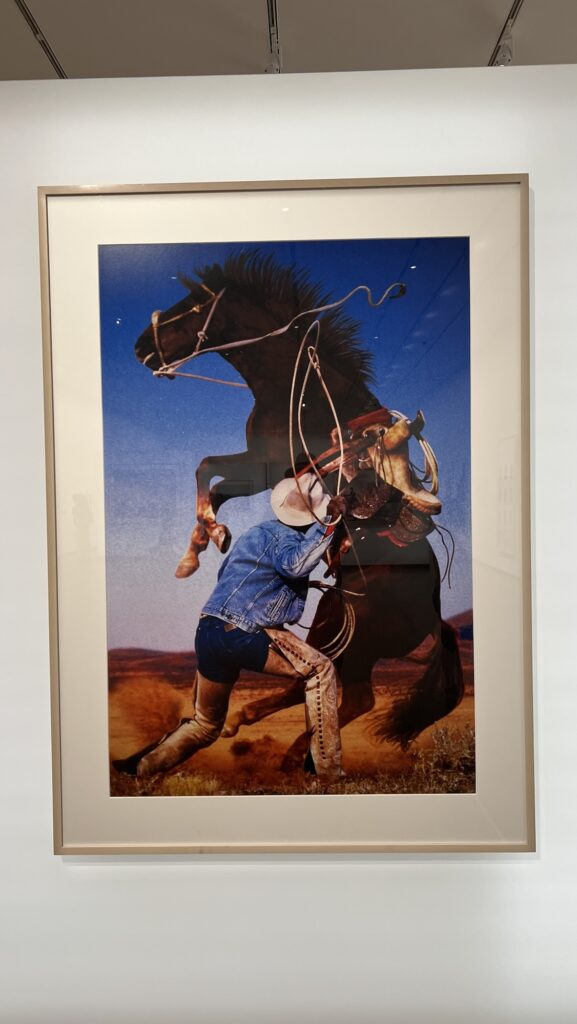
Tucked away in the basement was an unexpected bonus: Richard Prince, the American artist famous for rephotographing the Marlboro Man advertisements. Prince’s work is about appropriation, authenticity, and the mythology of American masculinity. He took a cigarette ad — a cowboy on a horse, wide open plains — and by reframing it as art, asked: who owns this image? Who owns the myth? His life and philosophy are as interesting as his work. A provocateur who made the art world question everything it thought it knew about originality.

Borrowing from The Dictionary of Obscure Sorrows by John Koenig, I once felt Koinophobia (The fear that you have lived, or will live, an ordinary and unremarkable life). However, over time it becomes clear that for everything there is an observer and the observed. Perhaps our entire purpose in life is to solely and emphatically observe or be observed. That’s the premise of 7senses.ai, travel, see the world, write, blog, experience and have AI serve as a travel companion to observe us as we observe others.
By the Numbers
Albertina Kombiticket (both museums): €29.90
Valid through: August 4, 2027 (one full year)
Artists encountered: 14 named above, plus dozens more
High school art teacher vindications: 1
💶 Day 21 Costs — Vienna Day 6
McDonald’s Wien Mitte — Muffin Bacon Egg + Latte + Hashbrown (breakfast): €6.60
Albertina Kombiticket — both museums: €29.90
Krazy Kitchen — Cashew Fried Rice + Chicken + drinks (Thai lunch): €17.80
Day total: €54.30
All paid with Chase Freedom (5x restaurant promo on dining charges). Receipts archived.
The Senses at the Albertina
👁 Vista: The dominant sense. Geometric abstraction, optical illusions, prism glass, the full sweep of modern art from Monet to Miró. The Albertina is a visual feast spread across two buildings.
🧭 Wander: The high school memory wasn’t planned. That’s the thing about Wander — it finds you. Vasarely reached across 40 years and told a Houston teenager he was right all along. That’s not something you can schedule.
👂 Cadence: The quiet of the basement gallery. The hush of the main halls. Museums have their own sound — the soft shuffle of footsteps, the occasional whisper, the silence that amplifies the art.
🙏 Sanctuary: Art museums are sacred spaces. Not religious, but spiritual. They’re places where you stand in front of something someone made 150 years ago and feel a connection that transcends time.
Because art isn’t just something you look at — it’s something that looks back at you, across decades, across continents, and sometimes across the judgment of a teacher who got it wrong.
Leave a Reply