
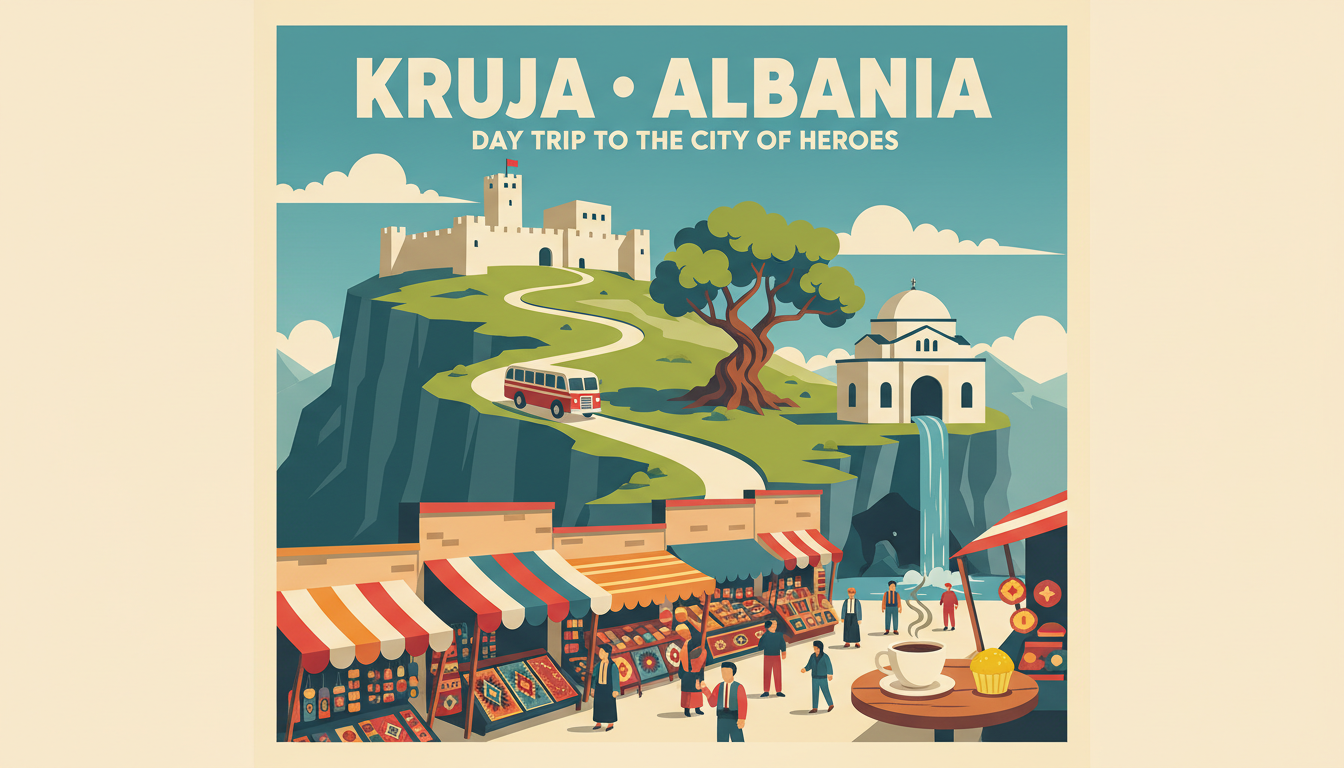
Some days begin with coffee and end with an olive tree that’s older than the Ottoman Empire. Day 15 was Kruja — the mountaintop fortress city that broke three Ottoman sieges, a Bektashi temple on a cliff edge, and the birthplace of Skanderbeg. But first: 45 minutes of bus pickups in the heat, and a drive up a mountain that made my ears pop and my knuckles whiten.
👅 Palate — Mon Chéri and the Hot Bus
I started the day with coffee and a lemon muffin at Mon Chéri — my Tirana regular now, a reliable 440 Lek for the pair. Then I hopped on the bus that was supposed to take us to the castle. After 45 minutes of bus pickups in a hot bus, I was already getting frustrated. This is the part of group travel nobody writes about: the waiting, the door opening and closing, the slow accumulation of bodies and heat while the mountain sits there in the distance, waiting.

🙏 Sanctuary — The Temple of Sari Salltiku
After finally picking everyone up, we headed to the very top of the mountain to visit a temple. It was one of the scariest and slowest drives up a mountain I’ve ever experienced — sheer rock cliff drop-offs, where a rockslide or a driving misstep meant instant death. Fortunately, nothing bad happened. The altitude was high enough to pop ears.
The reward at the top was the Temple of Sari Salltiku. Situated in the foothills on a cliff of Kruja Mountain, this temple marks the beginning of the history of temples in Albania. It was founded by Bektashi missionaries who settled in these areas decades before the Ottoman armies arrived. The work of Sari Salltiku in Kruja began in the first half of the 14th century — the temple takes its name from the Bektashi missionary Sari Sadik Babai, a student of Haxhi Bektashi, working alongside Baba Tomor.

The legend attached to the temple is extraordinary: it’s dedicated to the Dervishes of the Holy Sacrament, who fought to end the practice of sacrificing girls in ritual sacrifice. In the cave near the temple, an inexhaustible source of water flows. Sari Salltiku spread the Bektashi faith through Skopje, Ohrid, Kruja, and Ioannina, assisted by three dervishes — and during that time, Kruja became the most prominent center of Albanian Bektashi practice.
The temple fell to ruin during the communist regime in 1967 and reopened in 1991. Today it is the second-largest pilgrimage site in Albania, visited by pilgrims, citizens, and tourists of all religious beliefs. The peak pilgrimage season runs from August 14 to September 14 — which is exactly when I happened to be standing there.
In simplified terms, Bektashism combines Islamic belief, devotion to Muhammad and Ali, Sufi mysticism, and a relatively flexible approach to outward religious practice — placing particular emphasis on personal spiritual development and ethical behavior. It’s a faith built for the margins, and in Albania it found a home on a cliff.
👁 Vista — Krujë Fortress

Krujë Fortress was built in the 5th or 6th century, perched above the city that shares its name. During the Albanian Revolt of 1432–1436, the city was unsuccessfully besieged by Andrea Thopia and Ottoman rule was restored. But the fortress’s true legend came after Skanderbeg’s rebellion in 1443: it withstood three massive sieges from the Turks — in 1450, 1466, and 1467 — with garrisons usually no larger than 2,000–3,000 men under Skanderbeg’s command.
Mehmed II “The Conqueror” himself could not break the fortress’s small defenses until 1478 — ten years after the death of Skanderbeg.
Let that sink in. The man who conquered Constantinople couldn’t take this small Albanian fortress until its commander had been dead for a decade. Krujë Fortress sits at an elevation of 557 metres (1,827 ft), and today it’s a center of tourism in Albania and a source of inspiration to Albanians — a physical reminder that a small, determined people can hold the line against an empire.
👁 Vista — Skanderbeg Museum and the Olive Tree
The Gjergj Kastrioti National Museum (Skanderbeg) sits within the fortress — a museum full of history, with large murals and historical artefacts of Albania as its key features. Skanderbeg’s story is everywhere here: the nobleman who abandoned the Ottoman court, returned to Albania, and united its clans against the empire.

And then there’s the Skanderbeg Olive Tree — over 500 years old. Legend holds that the National Hero, Gjergj Kastrioti Skenderbeu, planted it on his wedding day with Donika Kastrioti. This created a tradition preserved for centuries: every young couple should plant an olive tree as a sign of peace and harmony for their marriage. Beneath its crown are the tombs of the babas and the dervish who served the temple of Dollma.

A wedding tree that became a national symbol. A tradition that outlived empires. I stood under a tree that was already ancient when Mehmed II was laying siege to the fortress beside it. That’s the kind of scale Albania keeps throwing at you, casually, like it’s nothing.
👅 Palate — Lunch with Two Finns

Lunch was in the restaurant with two Finns from the tour, on holiday. Both seemed to be avid adventurers with stories of their own — the kind of travelers you meet on mountain roads, who nod when you mention the scary drive and then one-up you with something from Lapland or the fjords. Good company for a long lunch. The total came to 3,950 Lek — a splurge, but the grill-house at altitude earns it.
🧭 Wander — The Old Bazaar
After lunch, I visited the bazaar and picked up a few items for back home. This was the last chance to pick up authentic souvenirs before I head out on Monday. The old bazaar at Kruja is a cobbled lane of woven carpets, copper, felt slippers, and woodwork — the kind of market that’s been selling to travelers since before the word “souvenir” existed.

The tour time ran out, and it was time to head back to Tirana. Down the mountain, ears popping again, the fortress shrinking in the window behind us. Kruja is one of those places that compresses a thousand years of defiance into a single afternoon — a cliff, a fortress, a temple, a tree, and a market, stacked up against the sky.
By the Numbers
| Item | Amount (EUR) |
|---|---|
| Mon Chéri — coffee + lemon muffin (440 ALL) | €4.21 |
| Kruja day trip — bus/guided tour | €25 |
| Grill-House lunch (3,950 ALL) | €43.89 |
| Old Bazaar — souvenirs | €20 |
| Day Total | €93.10 |
A cliff-edge temple from the 14th century. A fortress that outlasted Mehmed the Conqueror by ten years. An olive tree planted on a wedding day five centuries ago. A scary drive, a hot bus, and two Finns over lunch. Kruja doesn’t just teach you Albanian history — it makes you feel the altitude where that history was written.
Leave a Reply