
Tirana doesn’t ease you in — it drops you into Skanderbeg Square, 40,000 square meters of pedestrian plaza that won the European Prize for Urban Public Space in 2018. My first day in Albania’s capital took me from Cold War bunkers to Ottoman mosques to a dentist’s chair, with a meatball sandwich in between and a bag of potatoes that might — might — finally solve the Great Albanian Fry Crisis.
👁 Vista — Skanderbeg Square
Skanderbeg Square (Sheshi Skënderbej) is the gravitational center of Tirana — 40,000 m² of pedestrian plaza, the largest in the Balkans. It’s named for Gjergj Kastrioti Skënderbeu, the 15th-century Albanian nobleman who led a rebellion against the Ottoman Empire and became the country’s national hero. His equestrian statue stands at the square’s center.

The square as we know it was first laid out by the Austrians in 1917, but its layers run deep. During the Albanian monarchy (1928–1939), it was a roundabout with a fountain. Under communism, it hosted a statue of Stalin — later replaced by one of Enver Hoxha, which was torn down by student-led protests when communism fell in 1991. Today, the square is ringed by the National Historical Museum (with its iconic socialist-realist mosaic facade), the Palace of Culture, the National Opera, the Bank of Albania, and — most importantly for this day — the Et’hem Bey Mosque and the Clock Tower, standing side by side like two old men who’ve seen everything.

🙏 Sanctuary — Et’hem Bey Mosque
Completed around 1821 by Et’hem Bey Mollaj, this Sunni mosque is a survivor. During the communist era, it was closed and declared a historical monument — preserved but silenced. On January 18, 1991, at the onset of the fall of communism, 10,000 people entered the mosque carrying flags, despite opposition from communist authorities. It was a milestone in the rebirth of religious freedom in Albania.

What makes the mosque distinct is its frescoes — interior and exterior — depicting trees, waterfalls, and bridges. Not the geometric patterns you’d expect, but painted landscapes: imaginary scenes, the Süleymaniye Mosque of Istanbul rendered among them. A chronogram inside reads that “the mosque has given eternal beauty to the city, as Hagia Sophia has given to Istanbul.” That’s a bold claim for a small mosque in what was then an Ottoman backwater. But standing under its portico, looking across the square, you understand the sentiment.

👁 Vista — The Clock Tower
Right next to the mosque stands the Clock Tower (Kulla e Sahatit), built by the same Et’hem Bey Mollaj between 1822 and 1830. At 32.5 meters (107 feet), it was once the tallest structure in Tirana. It’s an Ottoman-era cultural monument, restored in 2010, with a clock mechanism that has been replaced and upgraded several times over nearly two centuries. The tower and the mosque together form the historic heart of the city — the sacred and the civic, prayer and time, side by side for almost 200 years.

🙏 Sanctuary — BunkArt 2
BunkArt 2 is the downtown sibling of the larger BunkArt 1 museum on the city’s edge. While BunkArt 1 occupies a massive anti-nuclear bunker, BunkArt 2 takes over the former headquarters of the Sigurimi — Albania’s secret police during the communist era. The same institution that surveilled, interrogated, and imprisoned thousands of Albanians is now a museum where you can walk through their interrogation rooms and read the files they kept. 900 Lek entry. Like the Site of Witness and Memory in Shkoder, it’s a place designed to make sure the machinery of state terror is never abstract — you stand in the room where it happened.


✋ Unwind — The Dentist and the Meatball
Albania is known for affordable medical and dental care. A teeth cleaning cost me €43 — a fraction of what I’d pay in Houston, and the quality was excellent. This is the kind of practical travel detail that doesn’t make it into guidebooks but matters enormously when you’re on the road for months. Your teeth don’t care that you’re in a new country.
For lunch, I stopped at Mulliri Vjetër Tetove and ordered a Bukë me Qofte Shtëpie — bread with homemade meatballs. 650 Lek, paid in cash. Simple, satisfying, the kind of working-class Albanian lunch that doesn’t try to impress you and therefore does.

👅 Palate — The Potato Purchase
After lunch, I dropped by the grocery store for water and soft drinks. But along the way, street vendors were selling fresh fruits, vegetables, and potatoes from wooden carts. And it hit me: this is how I solve the Great Albanian Fry Crisis.
I purchased a few potatoes to see if it’s the potato, the oil, or the cooking that is causing the great Albanian fry crisis. Tomorrow I will fry a potato in the Berat olive oil and begin deconstructing the mystery.
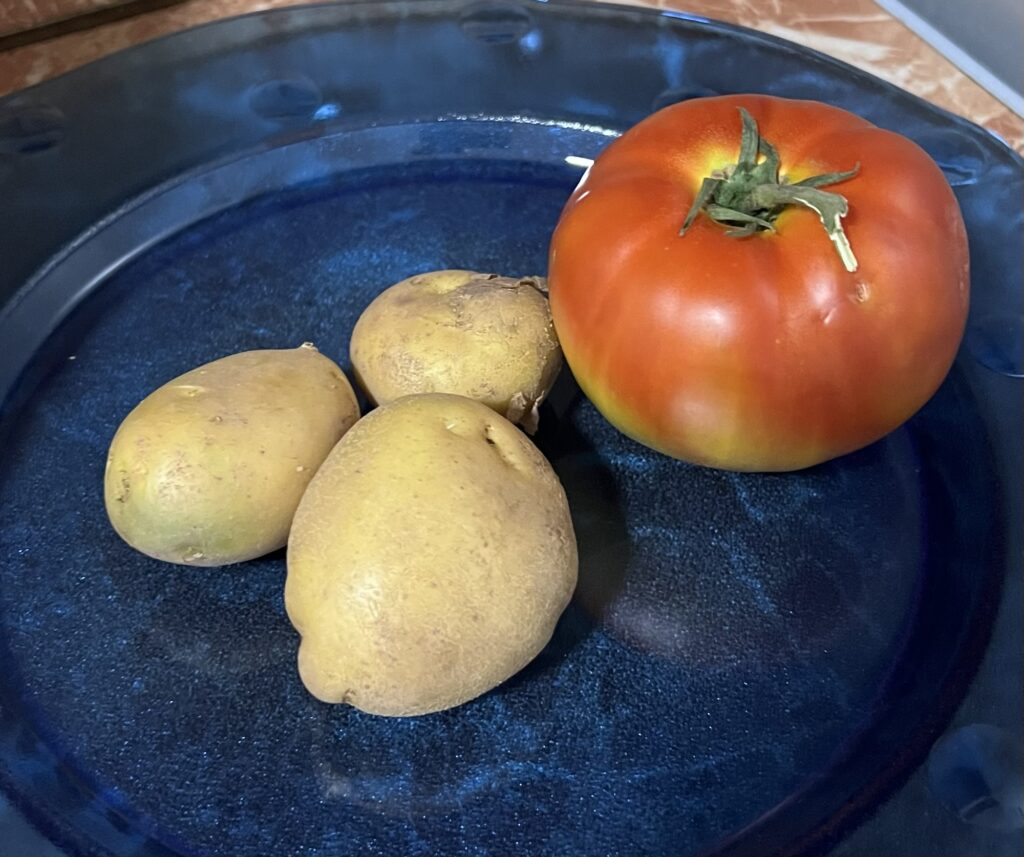
This is what happens when you’ve been on the road long enough. You stop just eating the food and start investigating it. The Burger King in Shkoder. The KFC. Every local restaurant. Not a single decent fry in the entire country. Tomorrow, in my Tirana apartment kitchen, I take matters into my own hands. Berat olive oil. Albanian potatoes. One pan. Science.
By the Numbers
| Item | Amount (EUR) |
|---|---|
| BunkArt 2 — entry (900 ALL, CSR 6670) | €8.61 |
| Dentist — teeth cleaning | €43.00 |
| Mulliri Vjetër Tetove — Bukë me Qofte (650 ALL, cash) | €6.22 |
| Spar groceries — water, soft drinks (641 ALL, cash) | €6.13 |
| Street vendor — potatoes for fry experiment | €1 |
| Day Total | €64.96+ |
One day in Tirana and I’ve already walked through a secret police HQ, sat under Ottoman frescoes, gotten my teeth cleaned, and bought potatoes for a scientific investigation. Three weeks in this city feels like the right amount of time. There’s a lot to unravel — and at least one potato to fry.
Leave a Reply