
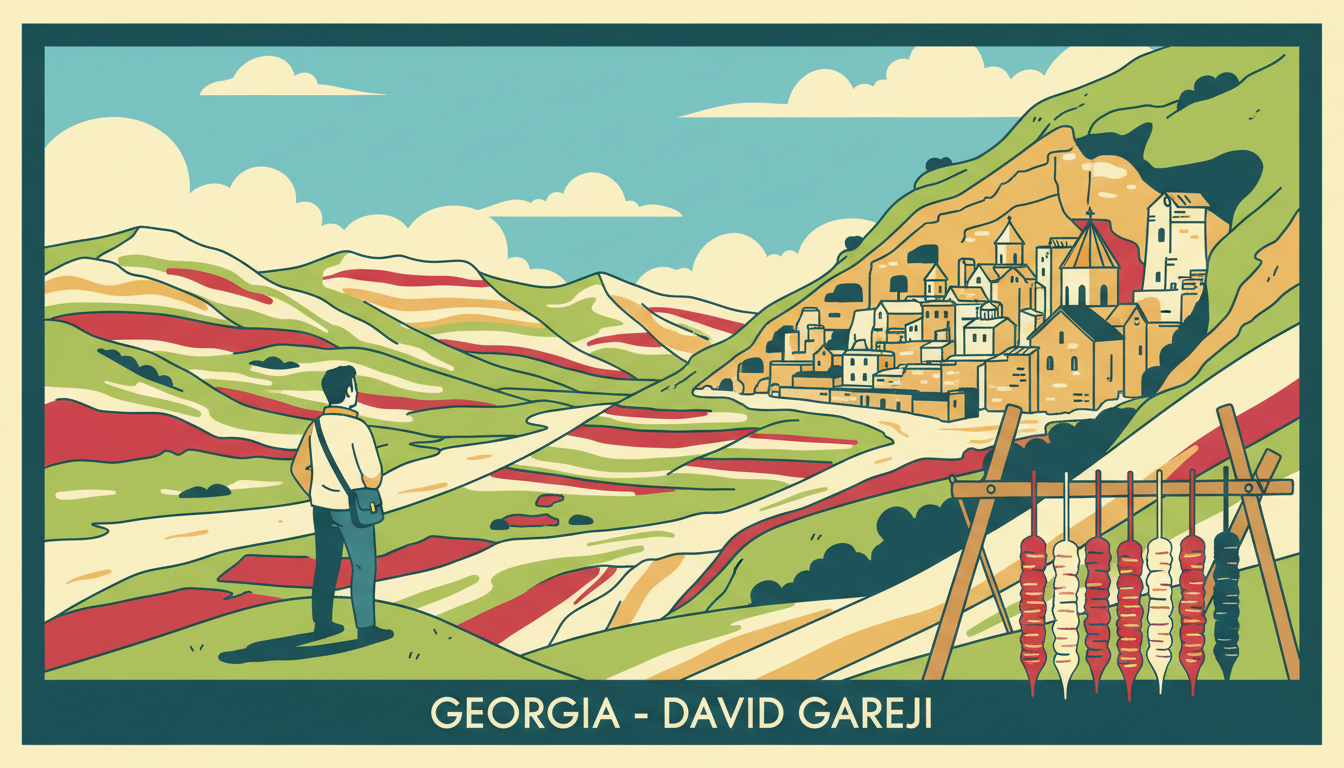
Woke up early. David Gareji day. The monastery is 60 to 70 kilometers southeast of Tbilisi, out in the semi-desert near the Azerbaijan border, and our tour was leaving at 10 AM sharp. Which meant one thing: McDonald’s breakfast. Not glamorous, but fast, predictable, and hot — exactly what a pre-tour breakfast needs to be.
The group assembled in the minibus and immediately clicked. A French couple, elegant in that effortless way only French travelers seem to manage. A brother and sister from Manchester, quick-witted and game for anything. A Polish solo traveler who’d been to Georgia three times and still hadn’t run out of things to see. And me. Five strangers, one minivan, and the open road to Kakheti.
Our driver and guide, Nugo, turned out to be one of those rare guides who doesn’t just recite facts — he tells stories. As we pulled out of Tbilisi, he started painting a picture of Georgian life: the family structures, the supra traditions, the way Georgians relate to their own history. By the time the vineyards of Kakheti gave way to the scrubland of the Gareja desert, I felt like I’d already gotten my money’s worth.
👁 Vista — David Gareji Monastery
The first sight of David Gareji stops you mid-sentence. The monastery is carved directly into the sandstone cliffs — not built onto them, but hollowed out of them. A honeycomb of caves, chapels, refectories, and monks’ cells that has been growing into the rock face for fifteen centuries.
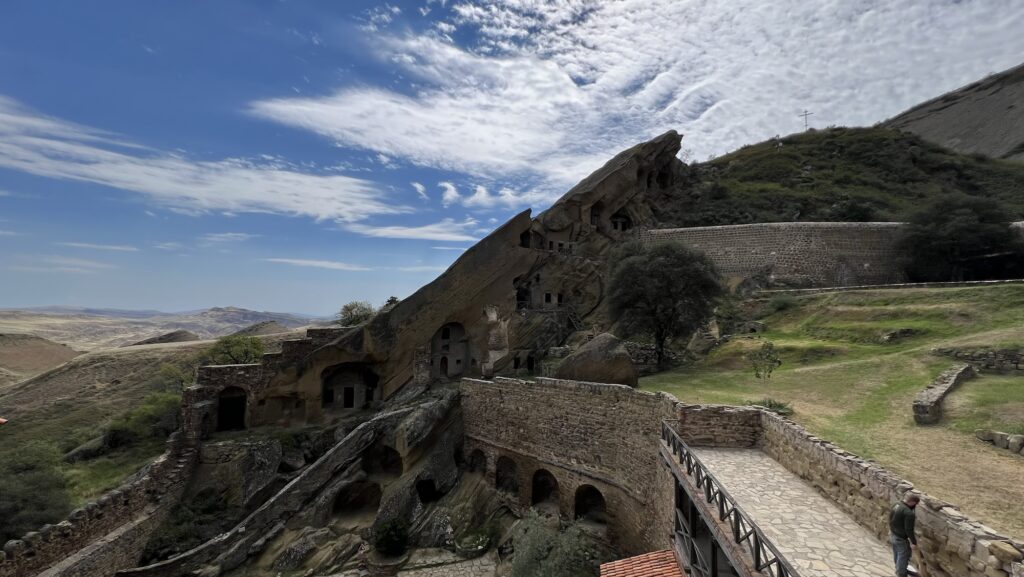
Founded in the 6th century by Saint David of Gareji — one of the Thirteen Assyrian Fathers who brought Christianity to Georgia — the complex grew over the centuries into a network of cave monasteries stretching along the ridge. At its peak in the medieval Georgian Golden Age, it was a major center of scholarship, theology, and manuscript production. It survived Mongol invasions, a devastating massacre by Shah Abbas I of Persia in 1615 (thousands of monks killed on Easter Sunday), Soviet-era military exercises that used the monastery walls for target practice — and, in 1987, a student-led protest movement that finally drove the Soviet army out. The monastery is still active today. You earn a place like this by refusing to die.
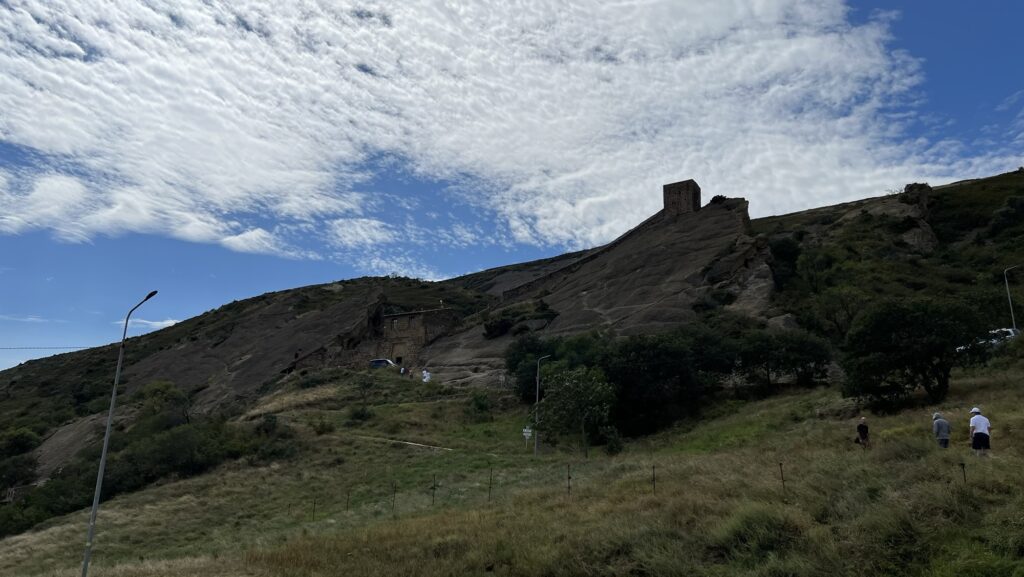
The location is strategic and spectacular. The complex sits on the edge of the Iori Plateau, straddling the Georgia-Azerbaijan border. Part of the monastery — the Udabno ridge — literally runs along the international boundary. You can stand on the ridge and look south into Azerbaijan. The border dispute remains unresolved as of 2026, and access to some sections shifts periodically. But the main Lavra monastery and the ridge walk are open, and that’s more than enough.
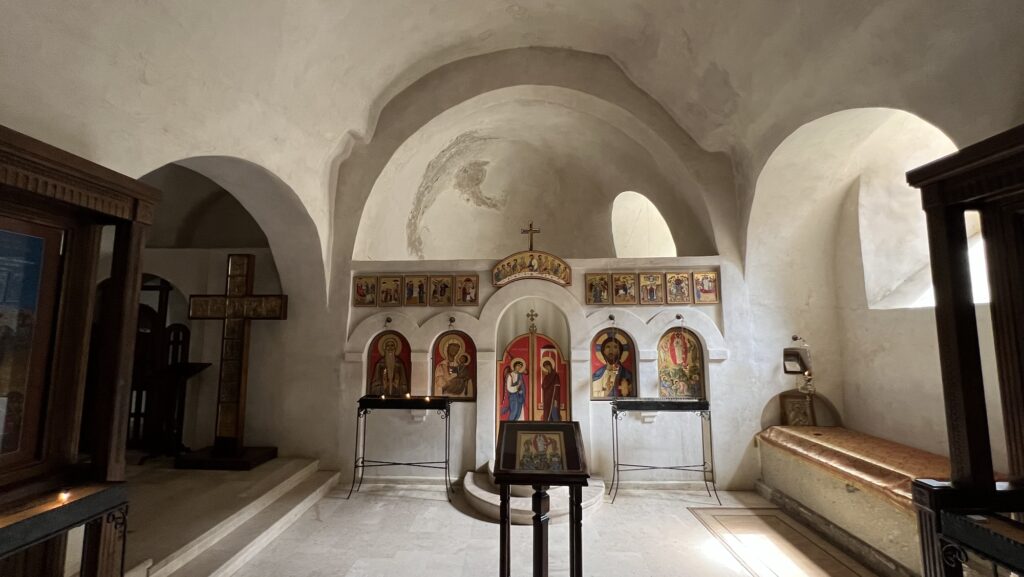
I spent a long while just standing in front of the Lavra, taking it in. The stone glows in the morning light — warm ochres and creams and pale pinks. The silence out here is not empty; it’s the kind of silence that has weight. You can feel the centuries pressing in.
🌈 The Rainbow Mountains
After photographing the monastery from every angle I could find, I started walking. The Rainbow Mountains — a series of eroded clay hills banded in yellows, reds, pinks, oranges, and whites — rise up behind the monastery complex. The colors come from mineral deposits in the clay, and they’re most vivid in the morning and late afternoon light.
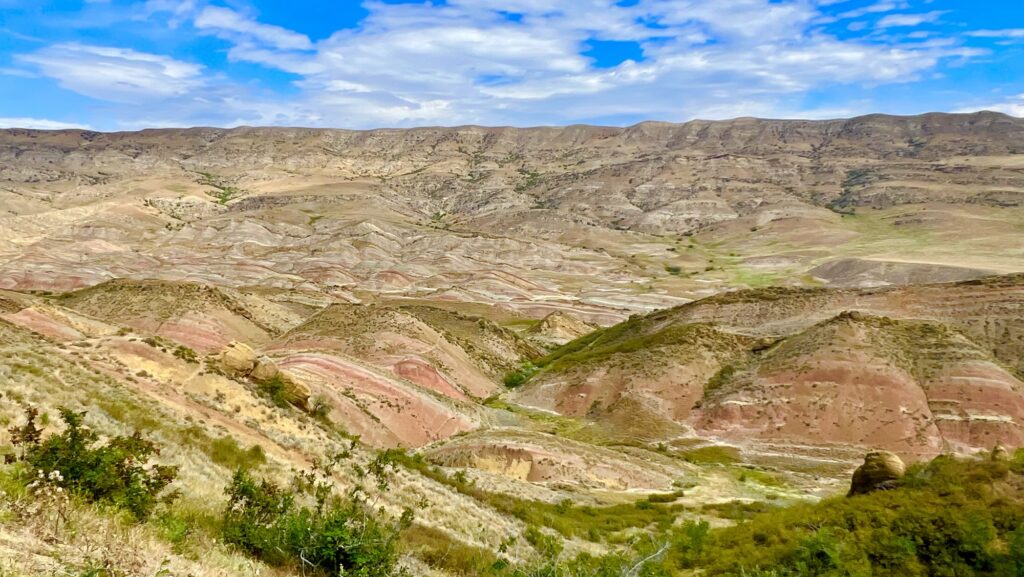
What struck me most wasn’t any single color but the contrast between them. The deep green of scattered trees. The pale gold of dry grass. The red and rust hues of the mineral hills. And above it all, a brilliant blue sky peppered with white clouds. It’s the kind of palette that makes you understand why Georgia claims such a deep connection to its land — the earth itself seems to be painting.
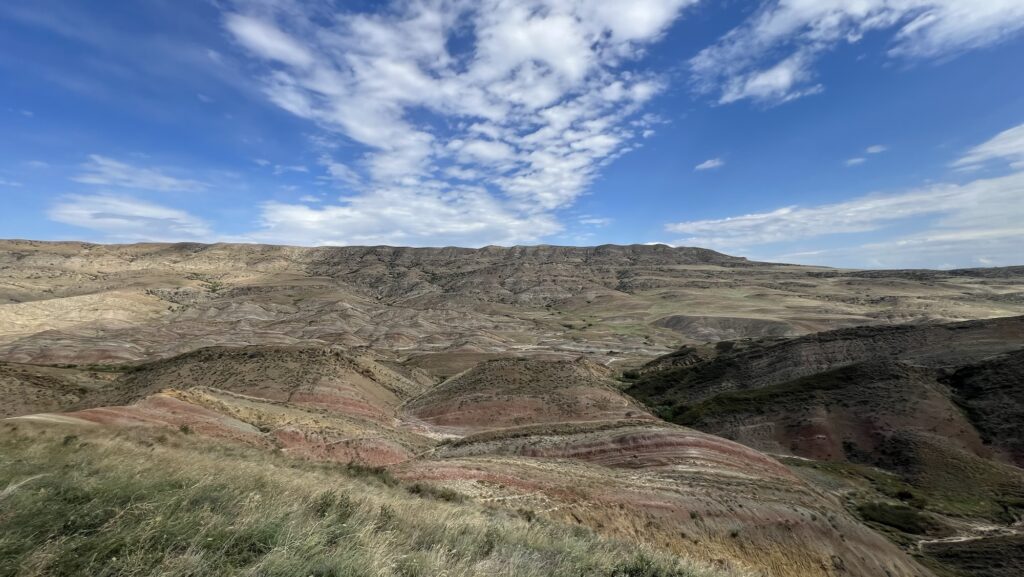
I climbed one of the higher hills — not a technical climb, but steep enough to get the heart going. Took photos at the top, breathing hard, the view stretching out in every direction. Georgia to the north, Azerbaijan to the south, and beneath my feet, rock that had been here since before anyone thought to carve a church into it.
Then I tried to climb down — and was promptly blown over by the wind. Not a stumble. A full, wind-powered, horizontal moment. The Gareja desert does not do subtle. One second I was a thoughtful traveler contemplating millennia of monastic history; the next I was a man-shaped kite reassessing my relationship with gravity. The Manchester siblings found this hilarious. They were correct.
👅 Palate — Churchkhela at Nato & Gio
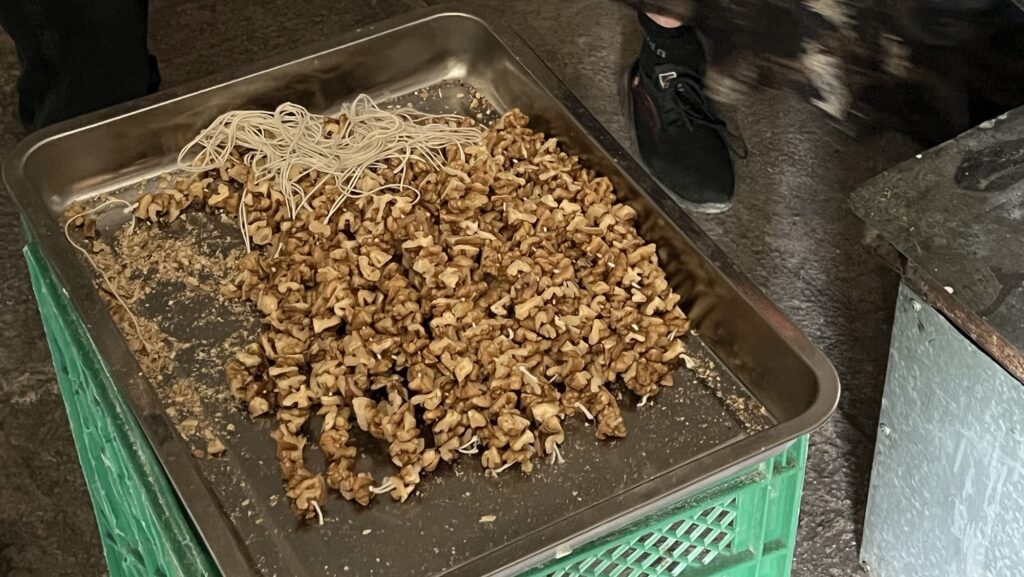
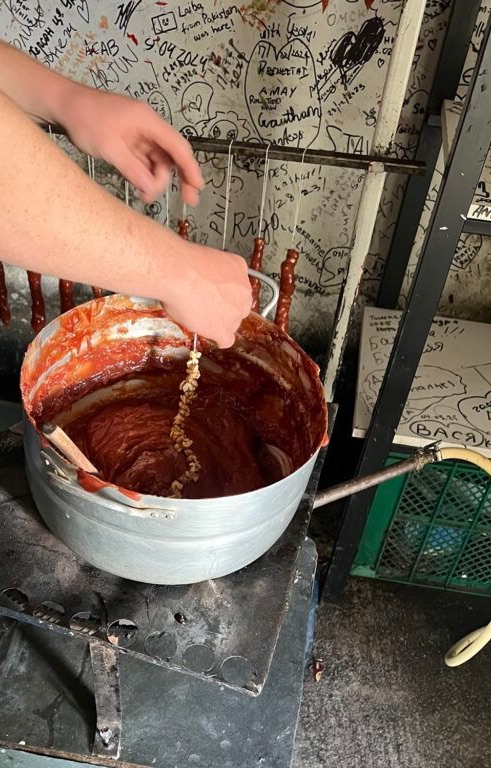
On the drive back, Nugo pulled over at Nato & Gio, a roadside stop famous for their churchkhela — Georgia’s traditional candle-shaped candy made by dipping strings of nuts into thickened pomegrate or grape juice and hanging them to dry. Churchkhela is to Georgia what energy bars are to the West, except it tastes like something and has been made this way for centuries.
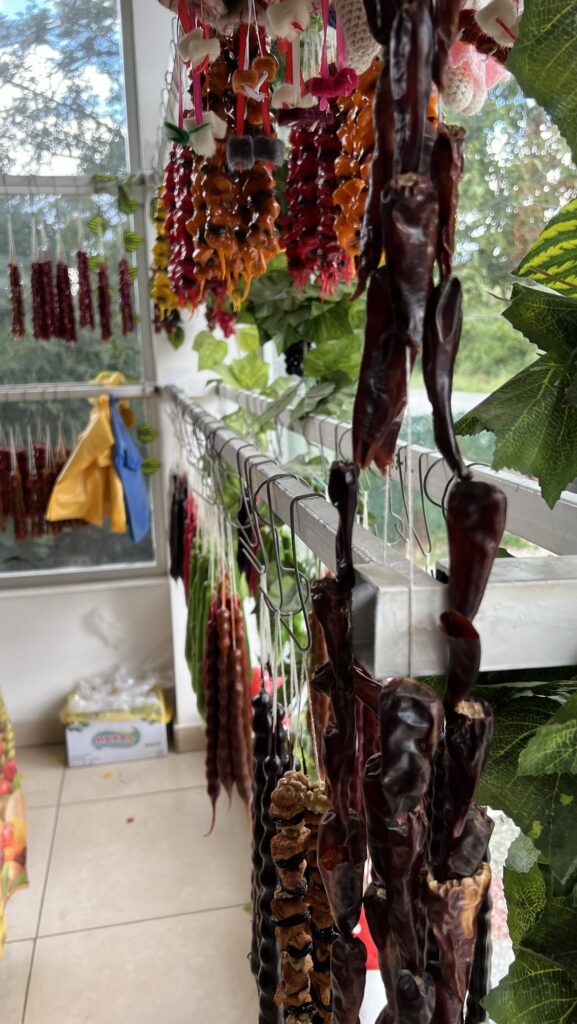
I sampled every flavor they had. Walnut, hazelnut, almond, mixed. Classic grape, pomegranate, and a few variations I couldn’t fully translate. Then they handed me a string of nuts and let me take a turn making my own — dipping into the thickened juice, pulling it out, hanging it to set. Mine came out crooked and uneven, the kind of churchkhela a Georgian grandmother would politely not comment on. I bought two coconut churchkhela and ate one before we made it back to the minibus.

👂 Cadence — The Georgian Road Playlist
The drive back was soundtracked by Nugo’s playlist of authentic Georgian music: Mgzavrebi, Bravo Metehi, Dito Qisishvili, Lela Nakeuri, 33a, and others I didn’t catch the names of. Georgian folk and modern fusion — polyphonic harmonies, driving rhythms, songs that sound ancient even when they were recorded last year.
There’s something about hearing a country’s music while watching its landscape roll past the window that no streaming algorithm can replicate. The hills of Kakheti scrolling by while Mgzavrebi’s voices filled the minibus — that’s not an audio experience. That’s a memory being forged.
We rolled back into Tbilisi in the late afternoon, dusty, wind-battered, and carrying the particular exhaustion that only a full day of desert, mountains, and monasteries can deliver. Five strangers who’d shared a minibus and a windstorm and a bag of churchkhela. Not friends, exactly — not yet — but something adjacent. Travel acquaintances at the exact right temperature.
By the Numbers
| Item | GEL | EUR (≈) |
|---|---|---|
| McDonald’s breakfast | 10.95 | €3.72 |
| David Gareji day tour | 73.41 | €24.97 |
| Coconut churchkhela (2) | 10.00 | €3.40 |
| Total | 94.36 | €32.10 |
Leave a Reply