
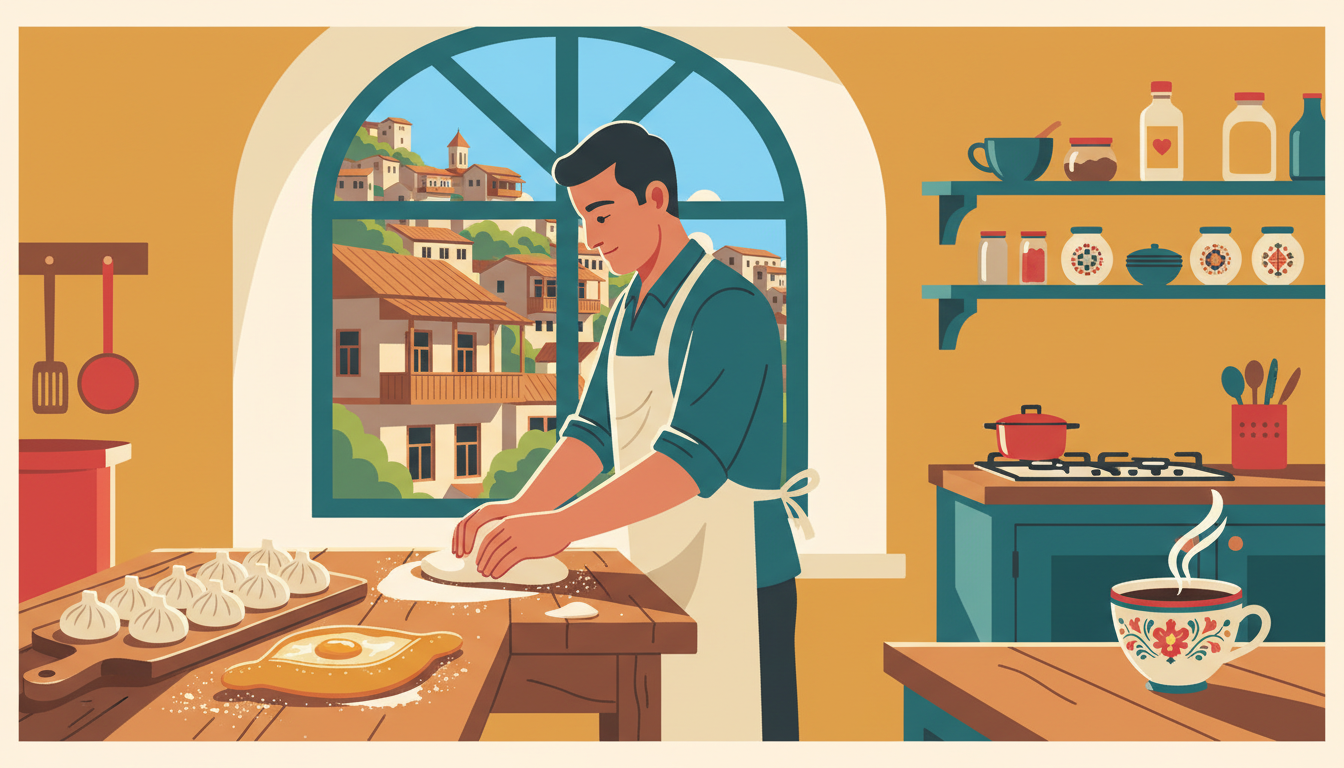
Day five in Tbilisi began with the kind of slow morning that long-term travel was invented for — an egg sandwich cooked in my apartment kitchen, a cup of coffee, and the familiar ritual of catching up on news from back home. No alarms, no itinerary. Just the tele and the quiet satisfaction of being exactly where I wanted to be.
But by noon, the kitchen was no longer mine. I had booked a Georgian cooking class at Bunny restaurant, and upon arrival I was given news that transformed an ordinary afternoon into something rare: I was the only student. Private lesson. One student, one chef, and several centuries of Georgian culinary tradition waiting to be passed on.
Khinkali — The Mountain Dumpling
Before my hands touched the dough, my host shared the story. Khinkali (ხინკალი) originated in the mountainous regions of northeastern Georgia — Pshavi, Khevsureti, and Tusheti — where shepherds needed a portable, calorie-dense meal that could sustain them through brutal winters where temperatures routinely drop below -15°C. The original filling was lamb, chopped coarsely by hand, seasoned simply with salt, cumin, and chili pepper. As the dish migrated down to the cities, pork and beef entered the mix, and vegetarian versions — mushroom, potato, cheese — followed for Orthodox fasting days.
Some food historians trace khinkali even further back, to the 13th-century Mongol invasions. The theory holds that the dumpling crossed the Silk Road as a half-moon shaped soldier’s ration — portable meat sealed in dough — before Georgian mountain communities reshaped it into the round, sun-symbol form we know today, their own Borjgali stamped onto a conqueror’s invention. Whether Mongolian dispatch or indigenous shepherd’s meal, what’s undeniable is that Georgia made it sacred.
Then came the hands-on part. My host demonstrated the delicate fold — the signature pleats that give khinkali its iconic garlic-bulb silhouette. You take a thin round of dough, spoon the seasoned meat mixture into the center, then begin the methodical work of pinching and twisting. Fold, fold, fold — each pleat overlapping the last — until the dumpling closes into a tight, twisted stem with a decorative knob on top. The stem isn’t just ornamental; it’s the handle. Traditional etiquette says you grip it, take a bite, and slurp the hot broth trapped inside before eating the rest. The stem itself is discarded — left on the plate like a spent cork, proof of another khinkali conquered.

I made five. The first was clumsy — too much filling, uneven pleats, a stem that looked more like a breadstick than a dumpling crown. The second improved. By the fifth, something shifted. My fingers found the rhythm and the work became meditative. There’s a quiet conversation that happens between your hands and the dough — a kind of negotiation where force is useless and patience is everything. The chef, I realized, does not merely assemble; the chef becomes one with the dough. It sounds mystical until you’re twenty minutes into folding pleats in a quiet Tbilisi kitchen and realize you’ve stopped thinking entirely.
Khachapuri — Georgia’s National Treasure
Next came khachapuri (ხაჭაპური) — Georgia’s national dish, a cheese-filled bread so fundamental to the culture that economists track its price across Georgian cities as the “Khachapuri Index” — the local equivalent of the Big Mac Index. The name itself tells the story: khacho (curd cheese) + puri (bread). In 2019, UNESCO recognized the khachapuri tradition as part of Georgia’s Intangible Cultural Heritage. There are over fifty regional varieties, but the two you’ll encounter everywhere are Imeruli — a round, double-crusted flatbread stuffed with salty Imeretian cheese — and Adjaruli — the famous boat-shaped version from the Black Sea region, crowned with butter and a raw egg yolk that cooks into a golden sun on the molten cheese.
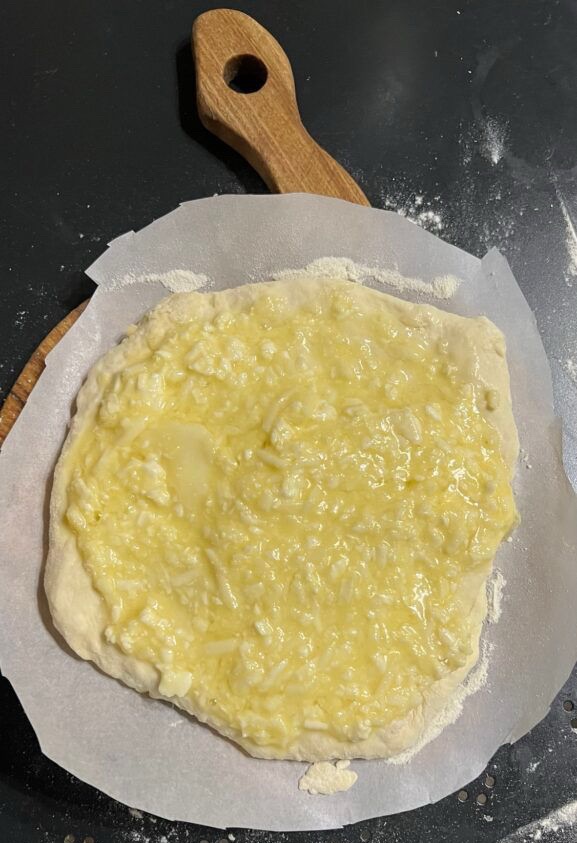
For me, the dough work was a time machine straight back to my college pizza joint days. I spent a stretch working as a cook slinging pies, and the muscle memory came flooding back the moment my knuckles hit the flour. Slam the dough down. Spread it flat with your fingers in a circular motion. Fold. Fold again. Flatten. Add the cheese mixture — a tangy blend of sulguni and Imeretian cheese — fold the edges into that distinctive boat shape, top with more cheese, and into the oven. When it came out bubbling and golden, we finished it the Adjaruli way: a pat of butter and a cracked egg yolk swirling into the molten center.
The finished products, when they arrived at the table, were savory and spectacular. The khinkali — plump, glistening, each one holding a spoonful of spiced broth inside its dough walls. The khachapuri — a cheese volcano with torn-off crusts for dipping. Eating food you made with your own hands, in the country where it was born, under the guidance of a patient local chef — there’s no restaurant experience that compares. In that moment, flour-dusted and beaming, I became a Georgian.

I had so much food left over that I’ll be eating well for the next couple of days. A cooking class that doubles as meal prep for the week — now that’s value.
👁 Vista — The Holy Grail, Found by Accident
Later in the early evening, I stepped out for something mundane — soft drinks from the corner shop. And right next door, as I glanced through a window, I found it. The holy grail. My new coffee cup.
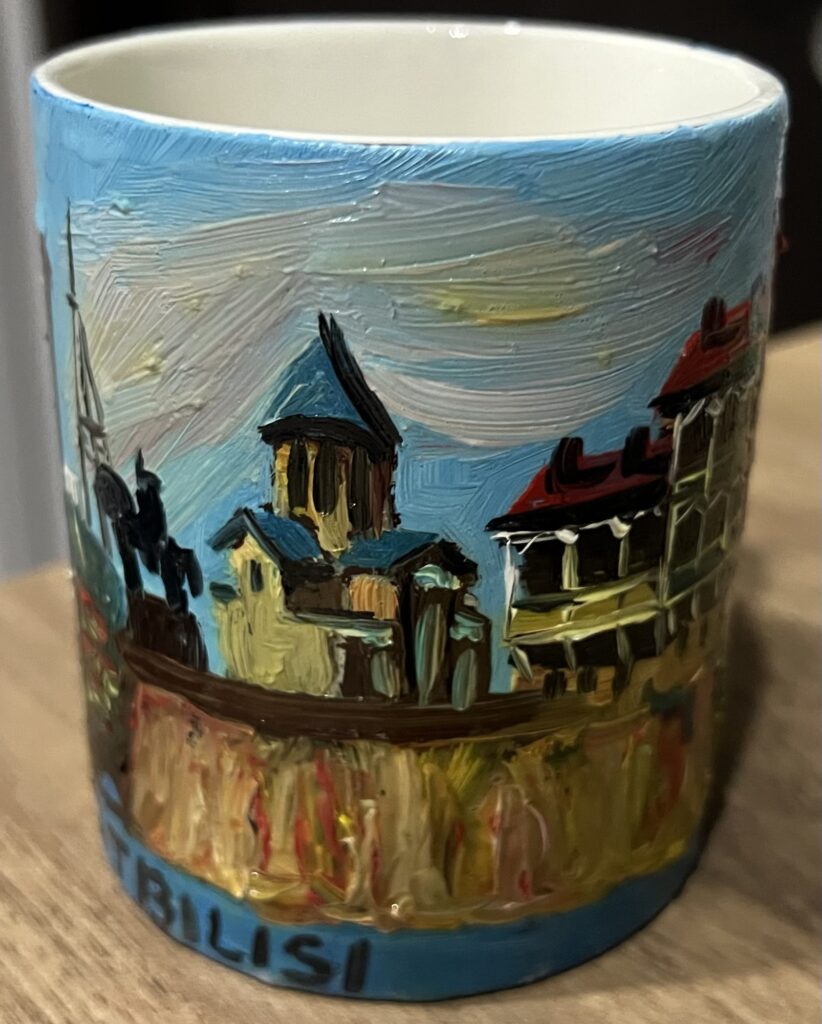
The shop was a small knicknacks and ceramics studio, and in the window sat a cup that stopped me mid-stride. Hand painted by the shop owner herself, decorated with Georgian folk motifs in deep blues and warm ochres against a cream glaze. It was the perfect size, the perfect weight, the perfect partner to my morning coffee ritual. 30 GEL — about ten euros — for a one-of-a-kind piece of functional art made by the person standing behind the counter. I handed over the lari without hesitation.
This is the quiet truth I keep rediscovering on this journey: my random, lost, unplanned experiences tend to lead to more golden finds than any meticulously researched activity. The cooking class was booked, yes — but the private lesson? The coffee cup? The moments that become the story are the ones I never saw coming.
Tomorrow, my morning coffee will taste different. Not because of the beans or the brew method, but because the vessel holding it was shaped by an artist’s hands in the same city where I’m learning to shape dough. Tbilisi, five days in, is already leaving its fingerprints on me.
By the Numbers
| Item | GEL | EUR (≈) |
|---|---|---|
| Cooking class (Bunny) | 81 | €27.55 |
| Lunch (Bunny) | 35 | €11.90 |
| Hand-painted coffee mug | 30 | €10.20 |
| Groceries | 30 | €10.20 |
| Total | 176 | €59.86 |
A private cooking class, lunch at the same table where I’d just made khinkali, a handmade ceramic mug, and a few days’ worth of groceries — 176 GEL, or about €60. In Chicago, the cooking class alone would have cost more than the entire day here. Georgia, five days in, is rewriting my sense of what travel value looks like.
Leave a Reply