
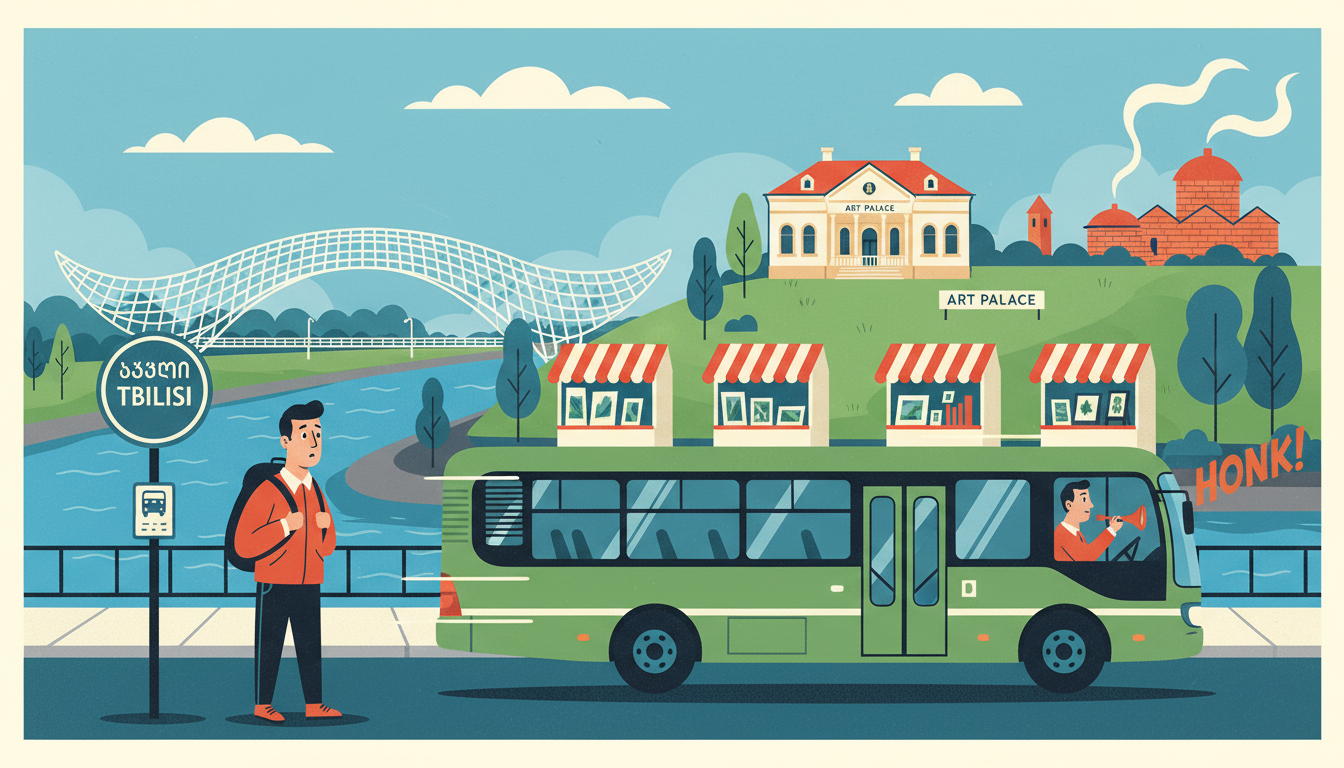
Tbilisi doesn’t really wake up till 10. Every city has its rhythm, and Tbilisi’s is late — the restaurants open at 9 if you’re lucky, the streets stay quiet, the buses run half-empty. On Day 4, with this knowledge in hand, I made my own breakfast. Groceries from the Day 1 run: eggs, bread, whatever else was in the fridge. At 8 am, with two hours to kill before the city stirred, I put a load in the washing machine. The cycle is two hours. By the time the clothes were clean, Tbilisi would be ready for me.
I had one mission today, and it was absurdly specific: buy a new coffee cup. The ones in the apartment are too small for my needs. I am a man who requires a certain volume of morning coffee, and the dainty espresso-sized cups of the rental-apartment-industrial-complex are not meeting my requirements. So I decided to head to the Meidan Bazar, the underground maze of stalls and shops near the Old Town, where surely someone would sell me a proper-sized coffee cup.
🧭 Wander — Lost, Three Times
I got on a bus. I got lost. I got on another bus. I got lost again. The bus number was correct. The direction was wrong.
This would become the defining feature of Day 4. Not the destinations — the state of being lost between them. I spent more time on Tbilisi buses today than anywhere else, and I spent most of that time going the wrong way. There is a particular feeling when you realize you’ve been on a bus for ten minutes and the landscape outside the window has gone from “approximately where you want to be” to “you have never seen this street before in your life.” It is not panic, exactly. It is the slow dawning recognition that you have surrendered control of your morning to a Georgian bus driver, and he does not know you exist.
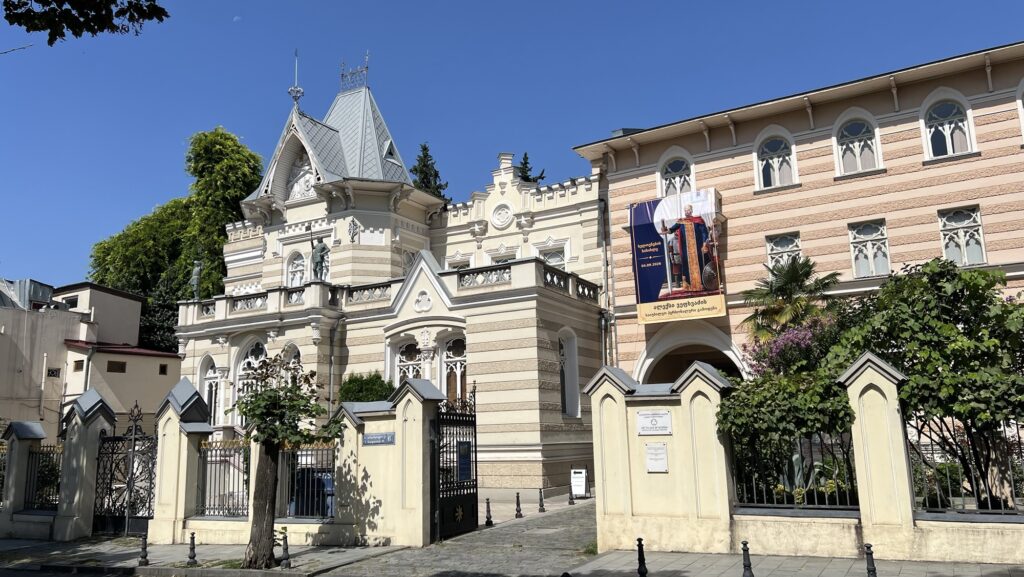
But here is the thing about getting lost in Tbilisi: the city rewards it. I finally got off the bus when I spotted the Art Palace — officially the Art Palace of Georgia-Museum of Cultural History, an estate turned museum on Kargareteli Street. Like a moth to flame, I instantly needed to see art. This is who I am now. I cannot walk past a museum without going in.
👁 Vista — The Art Palace
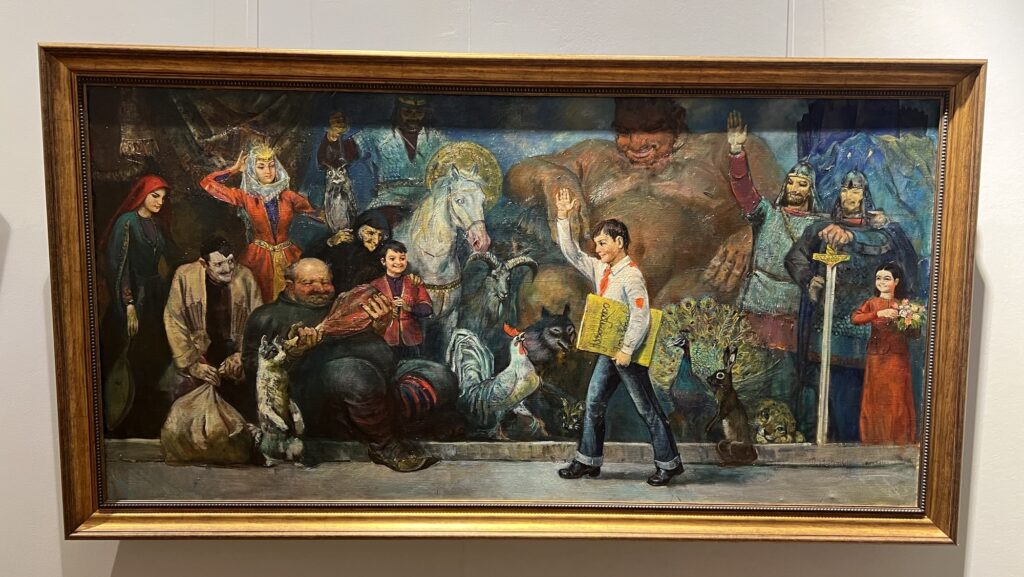
The Art Palace features Aleksi Vephkvadze, a Georgian painter whose work fills the rooms of what was once a private home. It is not a big museum — six or seven rooms, creaking wooden floors, the particular hush of a space that doesn’t get many visitors. But it was worth the stop. Vephkvadze’s style sits somewhere between Impressionism and Georgian folk tradition: landscapes, portraits, scenes of everyday life rendered with a warmth that the bigger museums don’t always have room for.
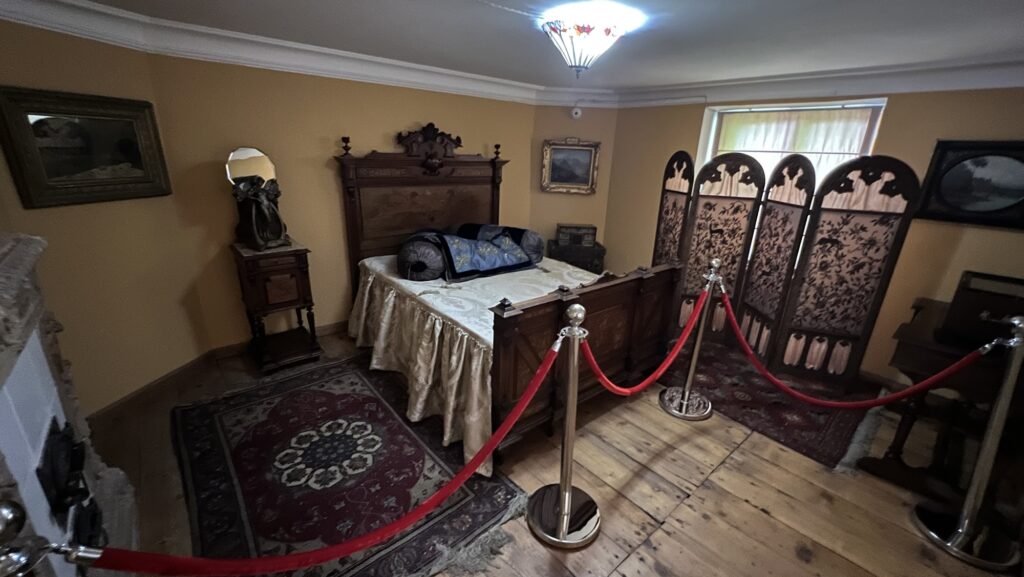
And there is a secret room in the attic. If you can manage the stairs — narrow, steep, the kind that remind you you’ve been walking all morning — and if you can squeeze through the tight space at the top, you find a small chamber with additional works. I won’t describe it further. That one, you should earn yourself.
👃 Aroma — The Bakery District
After the palace, I wandered the city streets of this neighborhood. I don’t know what the area is called. I couldn’t find it again if I tried. But it had bakeries — quite a few of them — and the smell of fresh-baked bread saturated the streets. Not the manufactured “fresh bread” smell of a supermarket vent. Real bread. Shotis puri, the traditional Georgian loaf baked in a clay tone oven, shaped like a canoe. The smell alone was worth the wrong bus. I didn’t buy anything. I didn’t need to. I just walked through it, breathing.
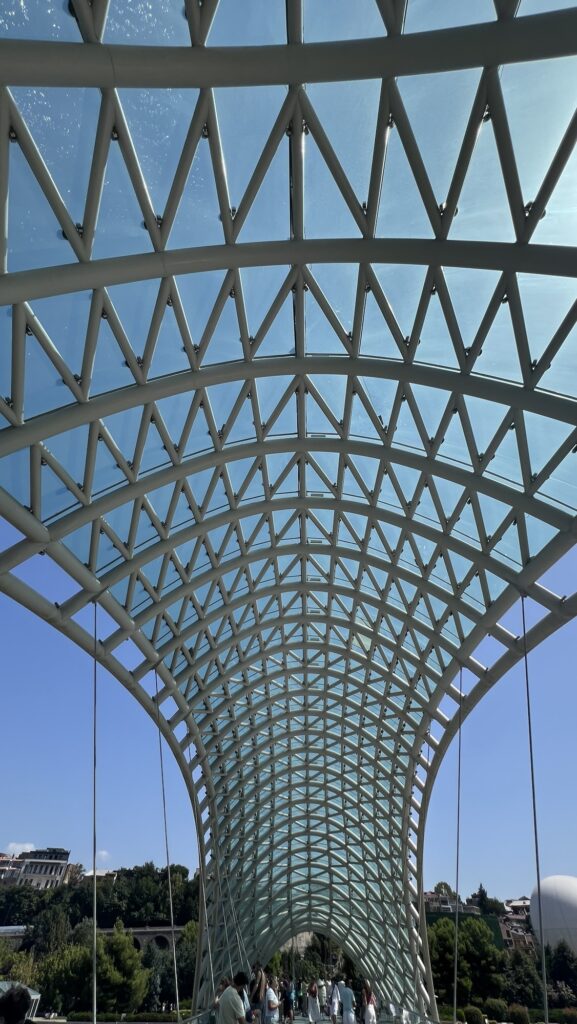
Eventually I reached a major hub — Mikheil Tsinamdzghvrishvili, a transit intersection where buses converge and disperse like a respiratory system. I found the 344, a green city bus that would, in theory, take me back toward the Old Town. In practice, the 344 took me on a drive around the city — a long, looping tour of Tbilisi neighborhoods I hadn’t planned to see, through roundabouts and across bridges, the driver accelerating for inches of gain and slamming the brakes for reasons that remained mysterious to me. I got off at Mshvidoba Bridge and walked to the Bridge of Peace — Tbilisi’s modern glass-and-steel pedestrian bridge, a bow-shaped canopy of LED lights that arcs over the Mtkvari. It’s a 2010 structure, controversial when built, now on every postcard. I took some photos. The bridge is beautiful. The photos are fine. I was, at this point, less interested in landmarks than in finding my coffee cup.
🧭 Wander — The Antique and Retro Bazaar
I walked to the Meidan Bazar — underground, cool, a warren of stalls selling spices, wines, jewelry, Soviet memorabilia, handcrafts. I picked up some spices but could not find the right coffee cup. The search continued. I got back on a bus. I missed my stop. I got lost. Again.
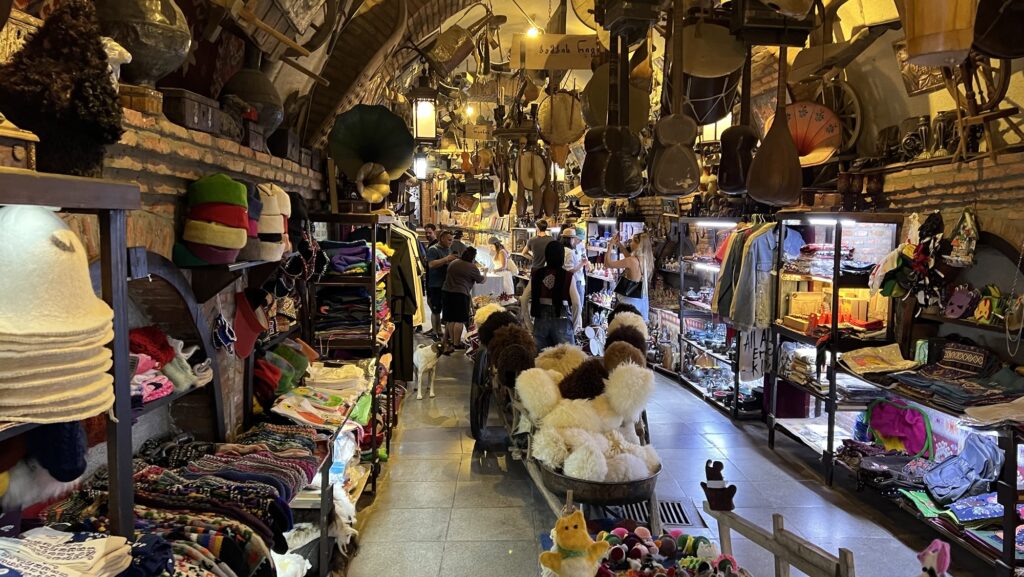
And then, walking back, I stumbled into a park filled with art vendors. I had spotted this park numerous times from the bus — a green strip between the river and a major road with endless traffic, tents and easels visible for a split second before the driver accelerated away. I never knew how to get to it. Now I was standing in it. The Antique and Retro Bazaar, across the street from the SwissHotel, is an open-air market where local artists sell paintings, prints, antiques, and curiosities. Great art by local artists. I didn’t buy anything — I am running out of wall space in my life and luggage — but I walked through slowly, taking in canvases of Old Tbilisi streetscapes, abstracts in Georgian colors, Soviet-era relics someone had pulled from an attic. The park exists in a liminal space between the river and the road, close to everything but invisible from everywhere. You have to get lost to find it.

🧭 Wander — A Brief Tbilisi Bus Survival Guide
About buses, and bus drivers, and general drivers in Tbilisi: I think they are probably the worst drivers in Europe, and maybe second-worst in the world. Constant slamming on the brakes. Constant acceleration for inches of gain. Constant honking — not the polite “I’m here” honk, but the sustained, aggrieved “WHY ARE YOU IN FRONT OF ME” honk that follows you down the street. Tailgating is a sport here. I have almost fallen forward and back the way these bus drivers stomp on the pedals.
But the worst part is the disregard for pedestrians. In Albania, the traffic was chaos, but at least drivers stopped at crosswalks. You will get no such courtesy in Tbilisi. You might get run over. I have had at least one close call every day here so far. I read that 500 people die each year in car crashes in Georgia — a country of 3.7 million. That’s roughly twice the per-capita road death rate of the US, and more than three times the European average. You feel it in your bones when you step off the curb.
So: how not to get lost on the bus in Tbilisi:
Step 0. Think carefully about whether you are better off walking. Seriously. If the distance is under 2 kilometers, walk. Your stress levels will thank you.
Step 1. Avoid the blue minivan buses. These are marshrutkas — small vans that fit only a few people. You have to tell the driver you want to get out at your stop, and he really has no interest in stopping. The blue buses are not public transit. They are a social contract between the driver and the road, and you are not a party to it.
Step 2. Take only the GREEN buses. The large municipal buses — green, numbered, with proper doors and a card reader. The 344, the 301, the routes that show up on Google Maps. These are still driven by people who learned to drive during a war, but at least they stop at designated stops.
Step 3. If you are in doubt about whether the next stop or the following one is your stop, get off as quickly as you can. On a few occasions I missed my stop, thinking it’s no big deal to get off at the next one. But the next stop may be across the river and around a rotunda and 3 kilometers from the last one — especially if you are on the 344. The bus system in Tbilisi does not respect the spatial logic of a compact European city. Stops are far apart. Bridges intervene. The next stop is not a correction; it’s a relocation.
👅 Palate — Savora
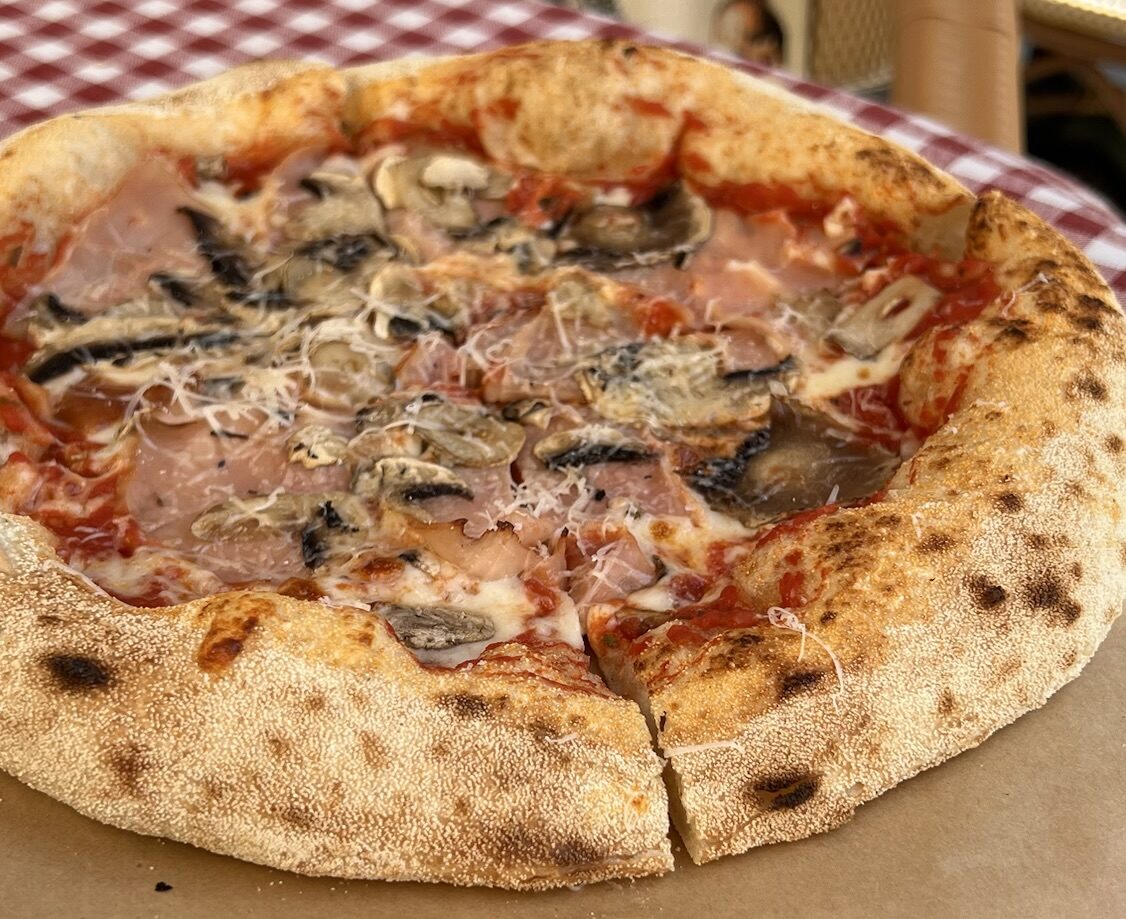
After walking back to my neighborhood, I stopped for lunch at Savora. 35 GEL for a Prosciutto Funghi pizza and tea. The pizza was quite good — thin crust, proper wood-fired char, the prosciutto salty and the funghi earthy. First pizza restaurant in Georgia, and it scores. In Albania, it took three tries to find a decent pizza (and I never really did — the Great Albanian Fry Crisis extended to pizza toppings, somehow). Georgia cleared the bar on the first attempt. While I ate, a film crew was working nearby. People dressed in tennis gear. I don’t know if it was a commercial, a TV show, or a movie. Nobody asked me to be an extra. Their loss.
After lunch: Carrefour Market, my go-to grocer. Without the benefit of a car, daily runs for items becomes a habit — you buy what you can carry, and you come back tomorrow for the rest. 30 GEL for more household supplies and groceries. Still no coffee cup.
👂 Cadence — Georgian Dinner & Dance Show
In the evening, I had a Georgian Dinner and Dance Show — Social Night. It was a bit far from my apartment. I ordered a Bolt. Then another. Then another. The fourth time was the charm. I thought I was dropped off at the wrong place. I may have been. But eventually I found the venue, and then the show began.
The program: Georgian Wedding — a staged traditional ceremony with costumes and ritual and the particular intensity of Georgian polyphonic singing. Russian Dance — the crouching kicks, the crossed arms, the controlled athleticism of the Cossack tradition. Batumi — something with the Black Sea port city, a regional dance I’m not cultured enough to classify but enjoyed enough to remember. And Sword Sparring Dance — men with swords, dancing at each other, the blades glinting under stage lights. It’s the kind of thing that could be kitsch and was, in moments, but was also genuinely thrilling. Georgia does not do its folk traditions ironically. They mean it.
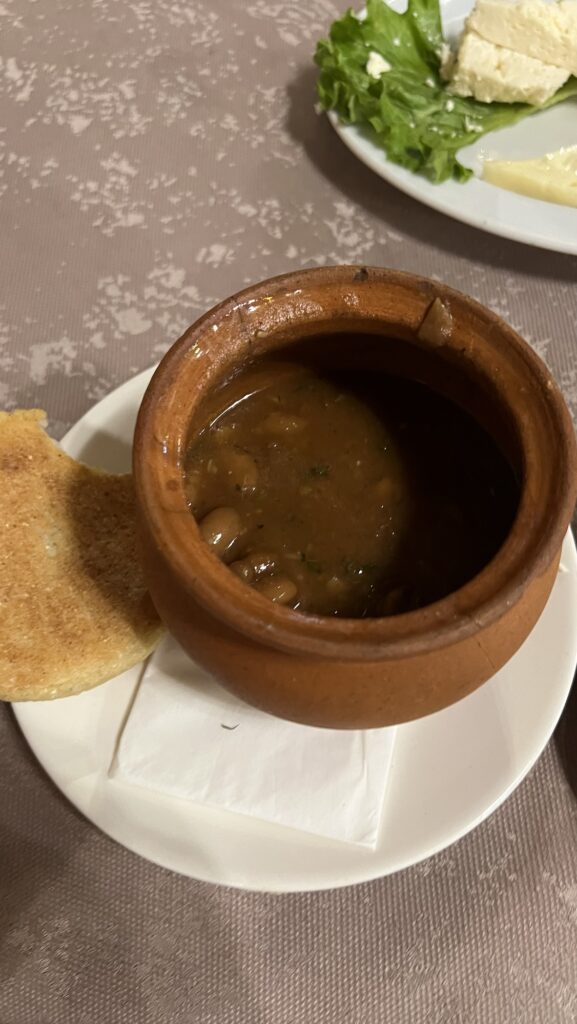
The food was plentiful. Clay pot beans that tasted a great deal like Frijoles A La Charro — smoky, rich, the kind of dish that makes you feel like someone’s grandmother is in the kitchen. Breads, cheeses, potatoes, hummus, stuffed peppers, a Greek-ish salad. The spread kept coming. For dessert, fresh fruit was brought to the table — a simple, honest end to a meal that had already given more than enough.
By the Numbers
| Item | Local | EUR |
|---|---|---|
| Savora — Prosciutto Funghi pizza, tea | 35 GEL | ≈ €11.90 |
| Carrefour Market — groceries and supplies | 30 GEL | ≈ €10.20 |
| Georgian Dinner and Dance Show — ticket incl. meal | 99 GEL | ≈ €33 |
| Bolt — 4 attempts (only 1 round trip ride completed) | 36 GEL | ≈ €12 |
| Day Total (known) | 200 GEL | ≈ €67+ |
A laundry cycle, three wrong buses, one Art Palace, countless bakeries, a hidden park full of painters, a pizza that restored my faith after Albania, and a Georgian dance show with sword-fighting. Tbilisi Day 4 — for around the price of a single Uber from IAH to the Houston Loop. Georgia continues to deliver, even when you can’t find the coffee cup.
Leave a Reply