
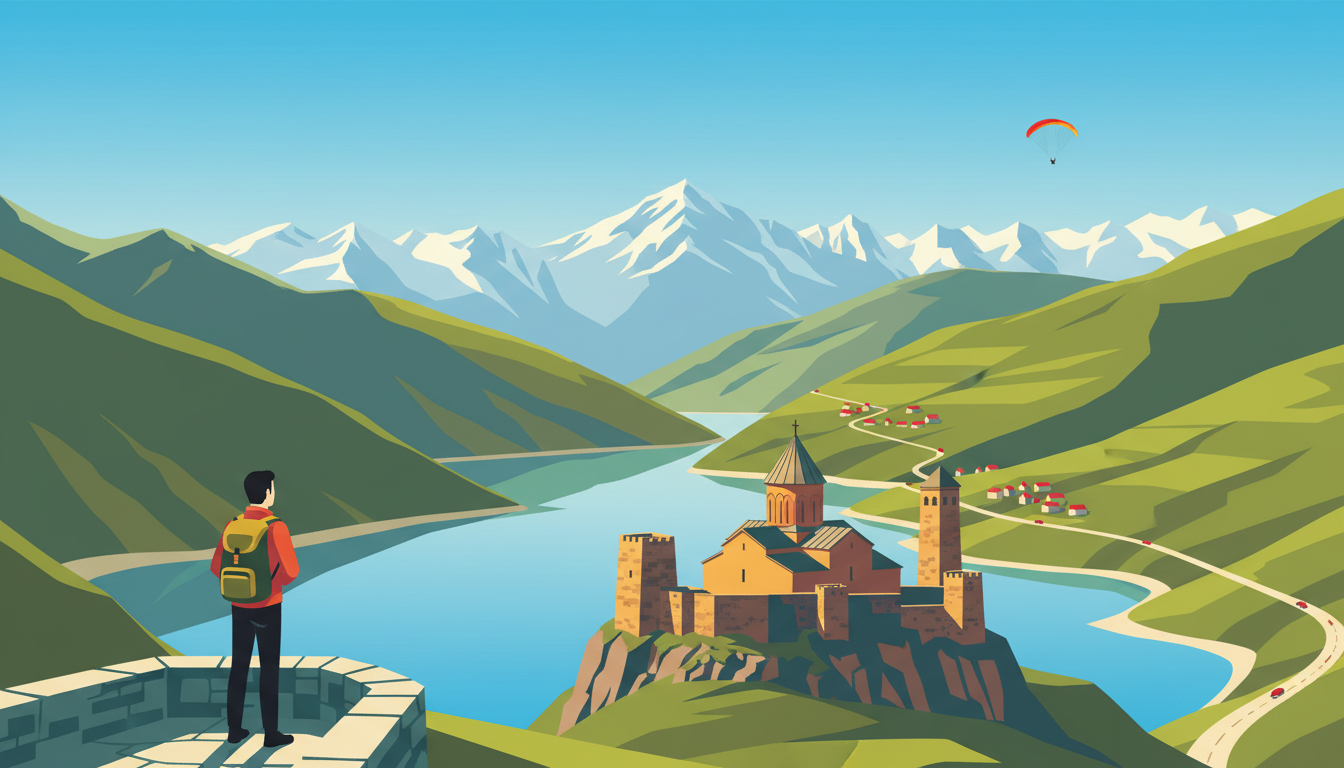
Day 12 was the big one. The Caucasus Mountains day. The Georgian Military Highway day. The kind of tour that packs five centuries of history, four epic viewpoints, one legendary fortress, and a paraglider or two into a single sweep north from Tbilisi toward the Russian border. Our guides, Nikolas and Josh, were knowledgeable and eager to share their wealth of Georgian wisdom — the kind of guides who answer the question behind the question.
👁 Vista — Zhinvali Reservoir
Our first stop was a panorama of the Zhinvali Reservoir — a vast turquoise lake formed by the damming of the Aragvi River, cradled between green mountains. The contrast is the thing: emerald-green slopes plunging into electric-blue water, the kind of color combination that looks photoshopped even when you’re standing in front of it. The reservoir supplies much of Tbilisi’s drinking water, but from this vantage point it looked less like infrastructure and more like a geological accident of unusual beauty.

🏰 Ananuri Fortress Complex
Ananuri was our second stop: a fortress complex perched on the side of a hill overlooking the reservoir. It’s one of those places where the history is as dramatic as the setting — and the setting is dramatic.

The complex was the castle and seat of the Dukes of Aragvi, a feudal dynasty that ruled this region from the 13th century until the 18th. It includes two churches — the older Church of the Virgin (first half of the 17th century, built of brick, abutting a tall square watchtower) and the larger Church of the Assumption — plus defensive walls and a watchtower with the distinctive stepped pyramidal roof that makes Georgian fortress architecture instantly recognizable. The Dukes of Aragvi were a powerful and frequently rebellious force in Georgian politics, and their castle witnessed centuries of battles.

In 1739, Ananuri was attacked by a rival duchy and set on fire. The Aragvi clan was massacred. But the fortress endured — and a legend grew around the name itself. According to local tradition, when the castle was under siege, a secret tunnel provided access to water, allowing the defenders to hold out. The enemy captured a woman named Ana from the village of Nuri and tortured her to reveal the tunnel’s location. She chose death over betrayal. The fortress was thereafter called Ana-Nuri, and she became a legend.
Beautiful views all around, impressive history, and a woman’s name spoken for three centuries because she refused to give up a secret. Some monuments are built of stone. This one is built of stone and loyalty.
👅 Palate — Lunch at Kakhaberi
We stopped at Hotel-Restaurant Kakhaberi for lunch, and the food was delightful. I ordered Shkmeruli — a Georgian dish I’d never tried before: chicken cooked in a white garlic sauce, served bubbling in a clay dish. It’s not quite a soup and not quite a stew — somewhere in the generous territory between the two, where garlic is not an accent note but the lead instrument. Creamy, pungent, deeply satisfying. The kind of dish that makes you wonder why you haven’t been eating it your whole life.

👁 Vista — Gudauri View Point
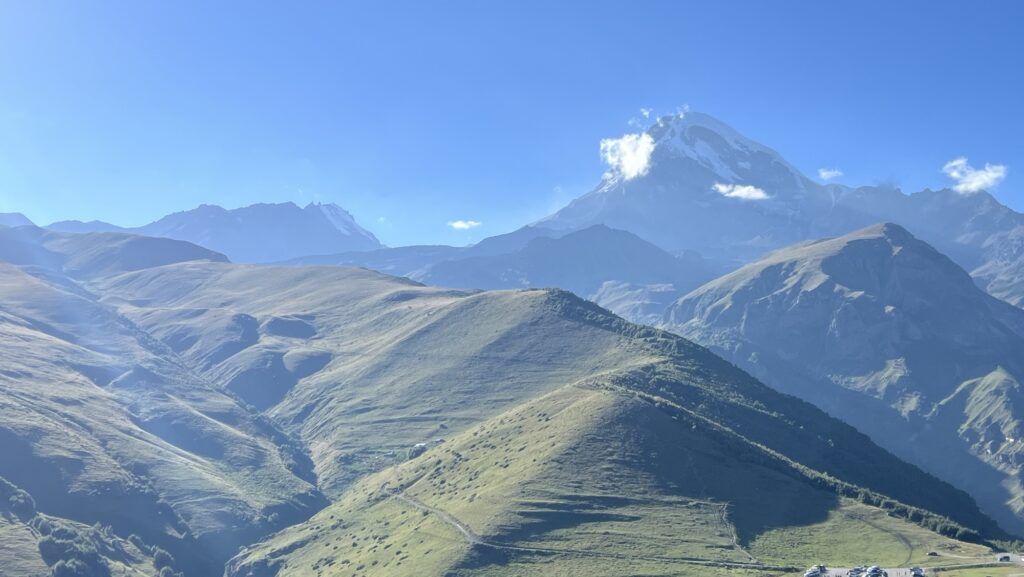
Next stop: Gudauri View Point. This is where the Georgian Military Highway reaches one of its highest drivable points, and the panorama opens up to the full scale of the Greater Caucasus. While some of our tour members took up paragliding — launching themselves off the mountainside into the thermals — I stayed earthbound, taking in the views and shooting photos I will cherish when I’m old.

There’s a particular quality to the air at this altitude. Clean, cold, thin — the kind of air that makes every breath feel like an act of deliberate refreshment. The place is serene and meditative. Perfect for reflection. Standing there, watching paragliders drift like seeds on the wind, I found myself doing the thing that mountains always make me do: taking stock. The noise of daily life strips away at altitude. What remains feels more true.

🙏 Gergeti Trinity Church

Then came Gergeti Trinity Church — sitting way on top of a mountain at 2,170 metres, the iconic 14th-century stone church framed by the colossal bulk of Mount Kazbek behind it. If Gudauri was impressive, Gergeti was transcendent. The views are even more majestic, the altitude even more humbling. The church itself is modest — a simple cross-in-square design, rough stone walls, a single bell tower — but that modesty against the scale of the Caucasus is precisely what makes it so powerful. Humans built this small stone box on top of the world because they believed something greater than the mountains deserved a house up here.

Far below, the village of Pansheti rests quietly under the mountains — tiny houses, green pastures, a ribbon of road disappearing into the valley. From this height, it looks like a model village, the kind of place that exists to remind you that people have been living in these mountains for millennia, long before the Georgian Military Highway, long before paragliders, long before tourists with cameras. The mountains don’t care about any of that. They were here first and they’ll be here last, and standing at Gergeti, you understand your place in that equation with unusual clarity.

An amazing experience. Not because of any single moment — the fortress, the lunch, the viewpoint, the church — but because of how they stacked together as the mountains got bigger and the air got thinner and the world got quieter. This is what the Georgian Military Highway does to you. It takes you north and takes you up and takes you, if you let it, out of yourself.
By the Numbers
| Item | GEL | EUR (≈) |
|---|---|---|
| Caucasus Mountains day tour ($35 USD) | 92.75 | €31.55 |
| Lunch (Shkmeruli, Kakhaberi — cash) | 37.00 | €12.59 |
Costs to come — receipt archaeology in progress.
Leave a Reply