
Day 10 was built around two pillars: a mountain and a concert hall. One reached by a 119-year-old railway climbing 770 metres above the city. The other sat in a palace garden, eight Georgian tenors singing polyphony into the autumn evening. Everything in between was just the city filling in the gaps.
👁 Vista — Mtatsminda Park
Mtatsminda Park is Tbilisi’s hilltop amusement and leisure park, perched on Mount Mtatsminda roughly 770 metres above the city. It’s one of the best panoramic viewpoints in Georgia and combines scenery, rides, restaurants, cafés, and green spaces into a single destination. The kind of place that would be a tourist trap in a lesser city and somehow isn’t here.
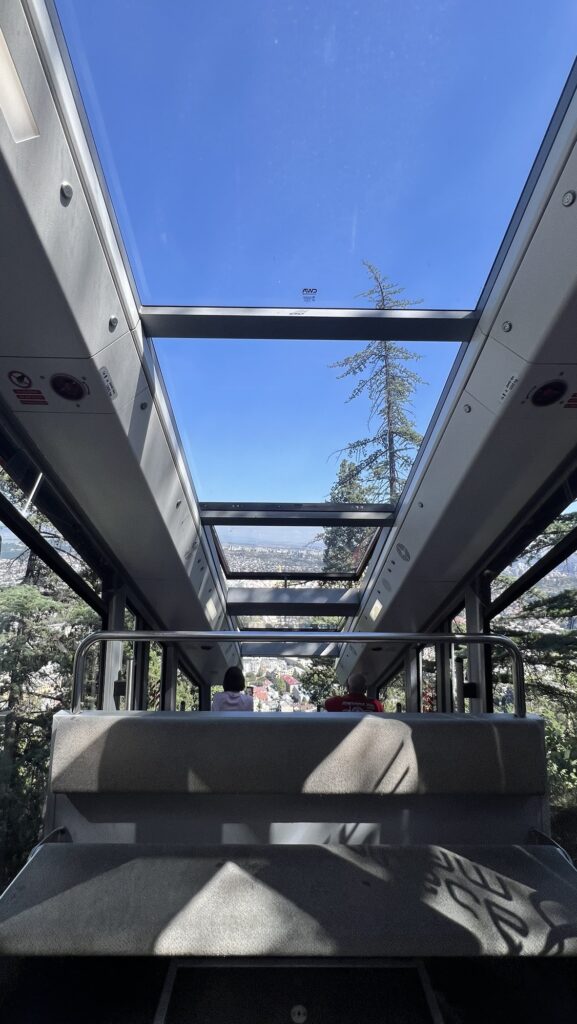
The classic way up — the way I took — is the historic Tbilisi Funicular from the Lower Station at 22 Daniel Chonkadze Street. 15 GEL for the ascent. The railway opened in 1905, and the short, steep journey up the mountain is an attraction in itself: wooden carriages, the smell of old machinery, the city dropping away beneath you as the pines close in. There’s a middle stop that gives access to the Mtatsminda Pantheon and Mamadaviti (St. David’s) Church, which I’d visit on the way down.
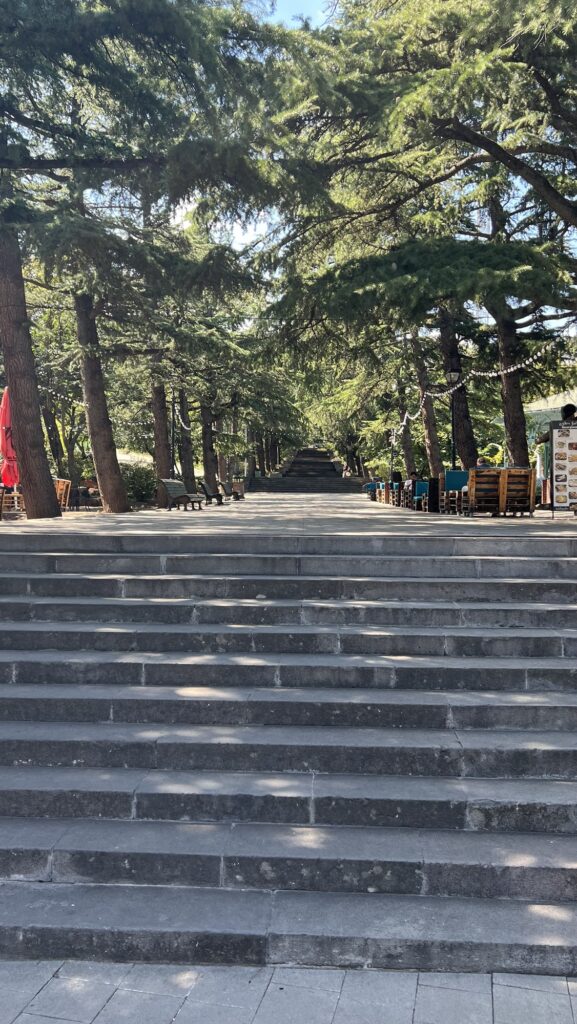
At the top, the park unfurls: the large Ferris wheel dominating the skyline, amusement rides for children and adults, walking paths winding through pine groves, cafés tucked into corners with mountain views. The park itself is generally free to enter — rides and transport are paid separately. The air is different up here. Cooler, cleaner, scented with pine and something floral I couldn’t identify. After nine days in the Tbilisi valley heat, 770 metres of altitude felt like a different season.
Ponchik and the Cliffside Wheel
I spotted a sign for Ponchik — a fried donut filled with custard, the kind of thing that appears at exactly the moment you need it. I ordered one with a coffee, sat down at an outdoor table, and let the scenery do the work. The park is covered with pine trees, flowers, and fresh mountain air. It is, without exaggeration, beautiful. Not Instagram-beautiful. The real kind, where you forget to take a photo because you’re too busy being there.

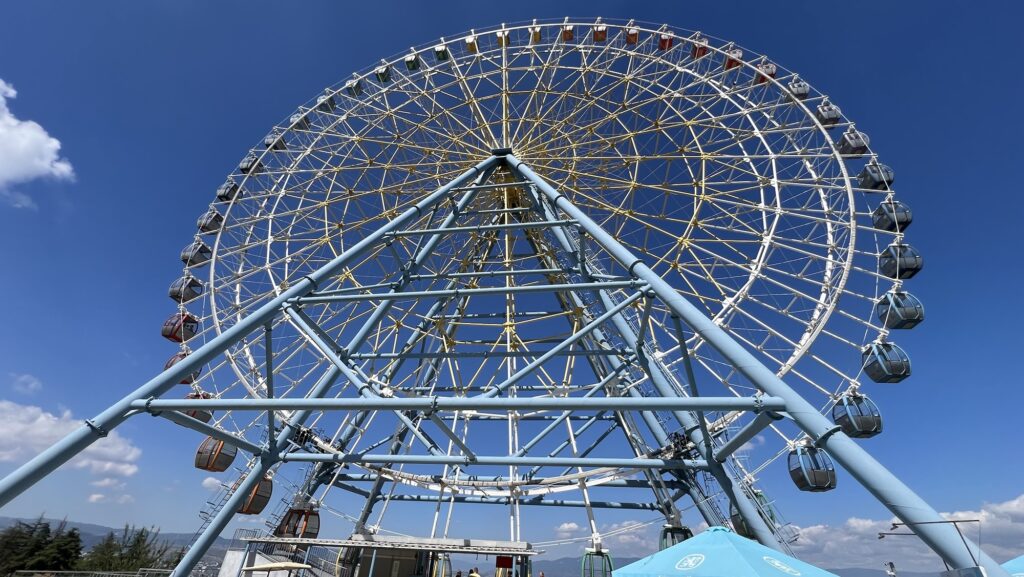
I walked further and came across the Ferris wheel perched on the edge of a cliff — exactly as dramatic as it sounds. 10 GEL for a ticket. The wheel turned slowly, each rotation revealing another angle of the stunning panoramic view: the city of Tbilisi from end to end, the Mtkvari River snaking through the valley, the mountains standing guard on every horizon. From up here, the city looks organized. Intentional. You know it’s not — you’ve walked its chaotic streets for nine days — but the distance edits out the mess and leaves only the geometry.
🙏 Sanctuary — Mtatsminda Pantheon
The ride down was 12 GEL, and I stopped at the middle station to visit the Mtatsminda Pantheon. This is where Georgia buries its most revered writers, artists, scholars, and national figures. The grounds are meticulously kept — not in the way of a manicured European cemetery, but with the attentive care of a place that is still actively visited and honored. Beautiful gardens, pathways winding between graves, majestic views of Tbilisi below and sheer cliffs above.
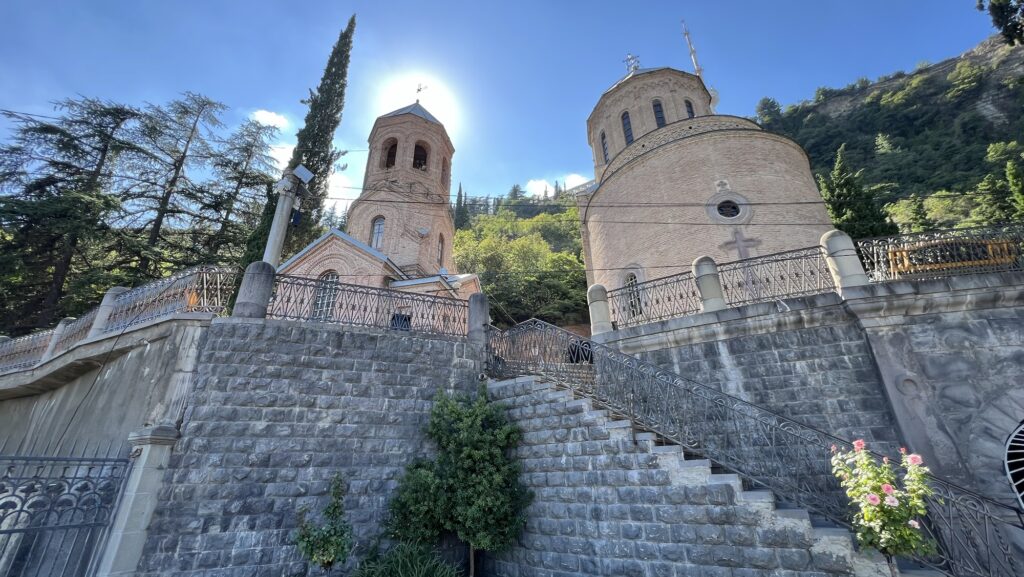
The pantheon sits on the same mountain as the amusement park, but the two worlds couldn’t be more different. Up top: children screaming on roller coasters, the smell of fried dough, the carnival hum. Down here: stone, silence, and the weight of a nation’s cultural memory. Georgia doesn’t separate its joy from its reverence — it stacks them vertically on the same mountain and trusts you to hold both.
👂 Cadence — Shvidkatsa & Nika Nikvashvili
In the evening, I attended a performance by Shvidkatsa & Nika Nikvashvili as part of the Autumn Evenings in the Palace Garden series. The venue: the Pupil’s and Youth Palace. The cost: 120 GEL. Worth every tetri.
The stage setup told part of the story before a single note was sung:
- Digital piano / stage keyboard — front-left/center
- Drum kit — center-rear: bass drum, snare/toms, hi-hat, cymbals
- Two conga drums — center-right
- Upright double bass — right side
- Electric bass guitar — black, leaning diagonally near the keyboard/drum kit
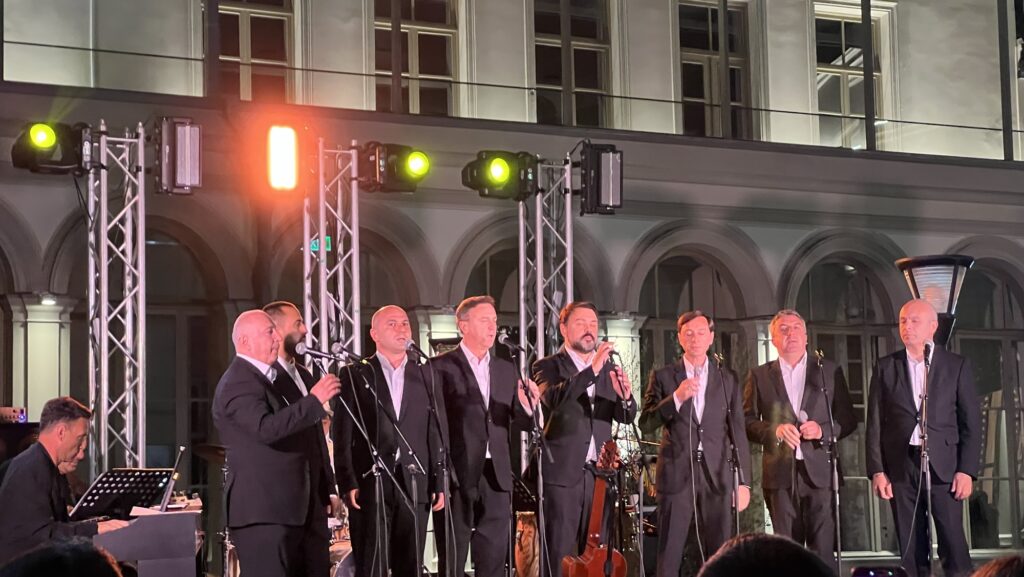
And then the voices. Eight tenors in Georgian polyphonic harmony — the ancient tradition of multi-voiced singing that UNESCO recognizes as a masterpiece of the oral and intangible heritage of humanity. Georgian polyphony is not like Western choral music. The harmonies move in ways that feel unfamiliar to ears trained on European scales. Dissonances that would be “wrong” in another tradition are exactly right here. The voices weave rather than blend — you can follow each individual thread while hearing the whole fabric at once.
I don’t understand Georgian. Not a word of it. But music is the universal solvent — it dissolves the barrier between languages, between cultures, between the singer on stage and the stranger in the fifth row. The performance was a serenade to the audience, to Georgia, and to the world. No translation required.
The palace garden, the autumn evening, the eight voices rising into the Tbilisi night — this was not background music. This was the kind of performance that recalibrates something internal. I walked back to my apartment through the quiet streets with Georgian harmonies still looping in my head, a soundtrack I didn’t understand and didn’t need to. Ironically, I once again found this event by accident on www.tkt.ge looking for something else. Another accidental discovery and another gem.
By the Numbers
| Item | GEL | EUR (≈) |
|---|---|---|
| Funicular (up) | 15.00 | €5.10 |
| Ponchik + coffee | 10.00 | €3.40 |
| Ferris wheel | 10.00 | €3.40 |
| Funicular (down) | 12.00 | €4.08 |
| Shvidkatsa & Nika Nikvashvili concert | 120.00 | €40.82 |
| Total | 157.00 | €56.80 |
Leave a Reply