

Shkoder doesn’t announce itself. It rumbles — motorbikes threading between parked cars on sidewalks, old men chattering over espresso in cafes thick with cigarette smoke, and somewhere in the old town, a woman named Yona is rolling out dough for 26 dishes. By the end of my first day here, I’d walked through a century of Albanian photography, tasted orange juice that tasted of Valencia, and sat at a table where 4 kilos of rose petals were just… around. This is Shkoder.
👁 Vista — Through the Lens of Time
A quick walk through the heart of old town — restaurants spilling onto cobblestones, shops selling everything from SIM cards to hand-embroidered linens — brings me to the “Marubi” National Museum of Photography (Muzeu Kombëtar i Fotografisë “Marubi”). I arrive at 8:40, ten minutes before opening. Cost: 700 Lek.

Downstairs, the work of Gege Marubi (1907–1984). Upstairs, the founding fathers: Pietro Marubbi (1834–1903) and Marubi Kel (1869–1940). These men were pioneers — not just of Albanian photography, but of Albanian seeing. Their images are a time machine: farmers in fields, families in doorways, weddings, funerals, the mundane and the monumental, all rendered in silver and shadow. The evolution of the Albanian face from the 1800s through the mid-20th century is both intriguing and strangely grounding. People were people. They worked, they loved, they posed stiffly for the camera just like our own ancestors did.


After Marubi, I duck into the Historical Museum of Shkoder — another snapshot back in time. Traditional clothing, tools, furnishings. The irony is not lost on me: aside from the cut of the garments and the absence of cars and traffic outside the museum walls, not much seems to have changed in the rhythm of Shkoder life.


👅 Palate — Breakfast at Nam Bistro
Before the museums, breakfast. Nam Bistro, a small spot in the old town. The special: avocado toast and juice. The waiter is stern-faced, efficient.
“The toast special.”
“What kind of juice?”
“What do you have?”
“Orange, apple, mixed.” He pauses. “Actually, only mixed.”
“Fine, bring me mixed.”
He leaves. Returns. They don’t have mixed either. He can bring fresh-squeezed orange.
“Well, that’s what I asked for originally.”
He smiles, laughs, and walks away. My first Albanian breakfast has begun.
The avocado is fresh, the bread is rye, a semi-boiled egg sits on each slice. But the orange juice — this is the revelation. I know these oranges. Or at least, I know their cousins. I’ve had fresh-squeezed orange juice in Valencia, Spain, and this glass is its close relative — the same tree family from the same region, I’d stake a meal on it. Bright, sweet with a backbone of acid, no bitterness. Phenomenal.

The coffee that follows is equally remarkable: dark, rich, with a trace of smoky depth I can’t place. An exotic bean, some roast technique I haven’t encountered. I make a mental note to investigate.
The tab: 910 Lek. Roughly €8.70. This meal would cost triple that in Houston and taste half as good.
👅 Palate — Yona’s Feast (26 Dishes)
Yona is a host who prepares 26 dishes for her guests. She is also, I learn, a software developer who built her own application to manage the business and dining side of her operation. But more on that later. First: the food.
The Opening Spread
Four kilos of rose petals sit on the table. Not as decoration — or rather, not just as decoration. They’re woven into the meal. The red/pink drink is called limonatë me petale trëndafili—Albanian rose-petal lemonade, it is made with 4 kg of rose petals. Ruki, a traditional drink made from grapes, is poured. It is alcoholic on the order of tequila x10, I take a tiny sip to taste it and I feel like I’ve just sipped rubbing alcohol.


Fresh vegetables – farm-fresh tomatoes, cucumbers, ripe olives and a yogurt sauce that tastes, improbably, like something from India — complex, tangy, spiced in ways that bridge continents.
Baked vegetables — farm-fresh, straight from the oven. The organic flavors survive the heat intact, which is the mark of vegetables grown in real soil. Pickles that I cannot decode — the flavor is familiar but the sub-components are elusive. I ask Yona: apple vinegar and salt. That’s it. The apples must be a local variety I’ve yet to sample because the result is unlike any pickle I’ve eaten. Simple, bright, completely itself.
Fried peppers with herbs — my favorite of the opening group. Optimal when laid on a slice of bread, the flavors savory and deeply organic. I’ve asked for the recipe.
Green peppers, fresh but slightly overcooked. Eggplants with olive oil, garlic, and parsley — the eggplant melts into the oil, the garlic is present but never aggressive. Cheeses: feta, crumbly and sharp, alongside katchkaval, which Yona describes as “Italian” in style — a semi-hard cheese that rounds out the plate.
The Deeper Courses
Dumplings in yogurt — the marriage of yogurt to dumpling is unusual, and it works. The yogurt is cool and tangy; the dumplings are soft and absorbent. Zucchini pancakes with cottage cheese — crispy, crunchy, packed with a rainbow of herb flavor. Every bite crackles. Cheese and parsley eggplants — another dish that refuses to hold back on flavor.

Tavel — a casserole of meat in cottage cheese with herbs and peppers. Baked until the edges caramelize, the cottage cheese lending a gentle tang that cuts through the richness. This is comfort food built for mountain winters.
Albanian pumpkin pie — a bit sweet and spongy but not intended as dessert. It exists, Yona explains, simply to counterbalance the herb-and-seasoning-filled flavors around it. A palate reset built into the meal’s architecture.
Grape leaves stuffed with rice, onions, and herbs. I’ve had this dish in many places — Greek dolmades, Turkish sarma, Lebanese warak enab. The spinach freshness stands out here in a way I haven’t encountered before. The rice is muted, almost recessive, letting the greens do the talking.
Burek — spinach and cheese, flaky layered pastry that shatters when you bite into it. A staple across the Balkans, but Yona’s version has the confidence of someone who’s made ten thousand of them.
Chorb — named after Turkish influences, a meat-and-broth soup with herbs and spices. It tastes amazingly similar to minestrone — the same soul, different geography. Meant to warm and restore.
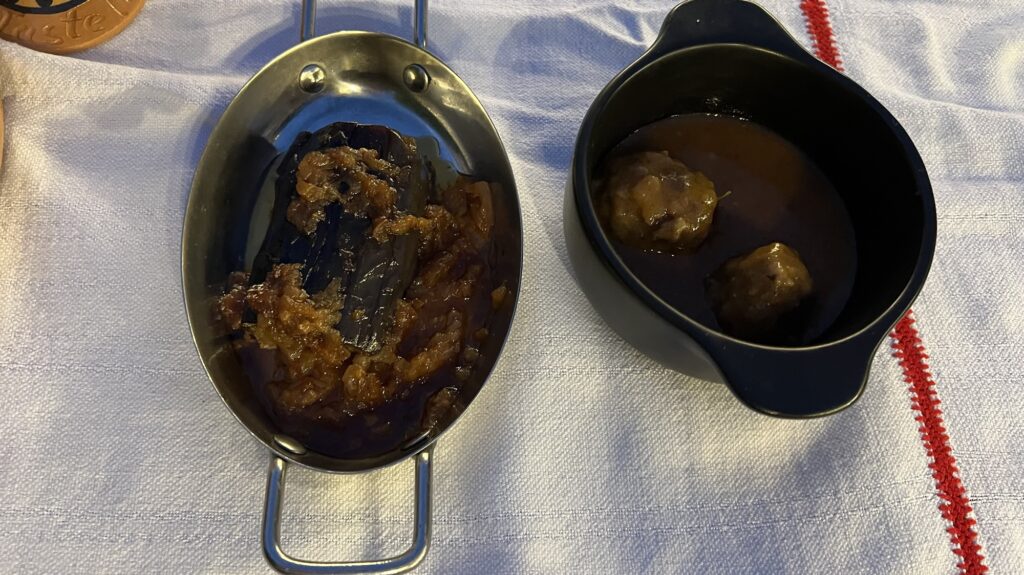
Imambayaldi — Turkish in origin, an eggplant dish where the vegetable, onion, and garlic are cooked to a mouth-melting perfection. The eggplant and seasonings seem to dissolve the moment they touch your tongue. There is no chewing, only yielding.
Meatballs in Albanian whey — fried, then cooked slowly until tender and soaked through with savory whey. This is the first meatball I have ever eaten where I can taste each component ingredient individually. The meat, the herb, the whey, the pepper — all distinct, all in conversation.
Am I becoming a dog?
👃 Aroma — Roses and Smoke
Four kilos of rose petals. Imagine the scent — a room saturated with floral sweetness, layered over the savory aromas of baking burek, garlic hitting hot oil, meat braising in whey. The air at Yona’s table is thick and alive. The Sauppler effect returns, this is a garden and there is food being cooked and served. There are waves of interlacing scents from flowers, cooked foods, and the occasional drift from the street.
Outside, Shkoder smells of cigarette smoke. It seems almost everyone here smokes, and the city is more properly an entire smoking zone with smoke-free zones as a rare premium. Cafes are clouded with it. Parks, too. It might explain why there’s a pharmacy roughly every 50 feet — that density of pharmacies suggests either poor health, an aging population, or both.
👂 Cadence — The City That Doesn’t Sleep (Literally)
Shkoder is loud. Last night, the music started at 9pm and kept going — all night, into the morning. Not background music. Loud music. The kind that vibrates through walls and makes you wonder if there’s a festival you somehow missed, or if this is just… Wednesday.
Traffic is bad, parking is worse — cars park on the street, the sidewalk, or in the middle of the street, whichever is closest to the driver’s destination. And yet, credit where it’s due: drivers stop for pedestrians. In the chaos, there is courtesy. Needless to say, if you have mobility issues, this place isn’t for you. In addition to cars parking on the sidewalk, the road to sidewalk transition can vary from a few inches to a foot or two.

🧭 Wander — Yona, Philosopher
About two-thirds of the way through the meal preparation, something shifts. Yona feels like family now. Good, because my own is thousands of miles away.
By the main course, Yona has shown me another side — she is a philosopher, lamenting that today’s youth seeks material riches and is becoming disconnected from the great and simple life people have had here for centuries. The peace. The organic foods. The nature. I can understand now the strong resistance to commercializing some of the islands, forests, and seaside territory. When you’ve lived the thing — the real thing — you know what’s being traded away. Ironically, many Americans are going to Albania to find what they themselves have lost.
She built her own software to run her kitchen. Her mother-in-law rolls grape leaves by hand when time allows, and mourns when it doesn’t. She stocks her table with 26 dishes and 4 kilos of rose petals because that is simply how you host. She is a technologist and a traditionalist, and in her kitchen, those two things don’t contradict. They just are.
Don’t have time to roll grape leaves. The culinary arts die from generation to generation because everyone is in a rush.
She’s right, of course. And that’s why this meal matters. Not just because it tastes extraordinary — though it does — but because someone is still doing the slow work. Someone is still gathering rose petals and simmering whey and rolling pastry by feel. This is not restaurant food. This is inheritance.
Book your tour with Yona here, you won’t regret it!
By the Numbers
| Item | Amount (EUR) |
|---|---|
| Nam Bistro — avocado toast special + juice + coffee (910 Lek) | €8.70 |
| Marubi National Museum of Photography — entry (700 Lek) | €6.70 |
| Yona’s traditional feast — 26 dishes ($47.50 USD) | €43.70 |
| Day Total | €59.10 |
Some meals you pay for with money. Others, you pay for with attention — the kind of sustained, grateful focus that recognizes you’re eating something that won’t exist in a generation unless people slow down long enough to learn it. Today cost both, and it was the best deal I’ve made in Albania.
Leave a Reply