

Day 3 in Riga was a full-spectrum assault on the senses — the sweet scent of strawberries in a zeppelin hangar, the thunder of a pipe organ vibrating through 800-year-old stone, a Michelin-starred beetroot that made us whole, and roast chicken eaten by candlelight in a medieval dungeon. If Day 2 was about art and cheese, Day 3 was about scale: the massive, the towering, the cavernous — and the unexpectedly sublime.
👃 Aroma — Riga Central Market
We started the morning at Riga Central Market, housed in five converted World War I zeppelin hangars along the Daugava River. It’s one of the largest markets in Europe and a UNESCO site — but the numbers don’t prepare you for the smell. The produce outdoor stalls hit you first: strawberries, apricots, and cherries piled high in wooden crates, their sweetness cutting through the cooler morning air. Then garlic, cucumbers, and tomatoes — the savory backbone of every Latvian kitchen. In the back, buckets of cut flowers add a floral top note to the symphony.
The indoor halls are filled with spices, meats, cheeses, honeys, breads and more.

Because a market isn’t a grocery store — it’s a city’s breath, exhaled in produce and petals.
👅 Palate — Dumpling Corner Cafe, Milda & Lasite
We paused for a ham and egg omelet at Dumpling Corner Cafe, a no-frills stall tucked among the market bustle. Simple, honest, and exactly what you want when the morning has already stretched your legs and your senses.

👁 Vista — Latvian Academy of Sciences & House of the Black Heads
Between the market and the cathedral, we passed the Latvian Academy of Sciences, a Stalinist-era skyscraper that locals affectionately call “Stalin’s Birthday Cake.” Built between 1951 and 1961, it’s a striking example of Socialist Classicism — Latvia’s first high-rise, decorated with Latvian folk motifs and hammer-and-sickle ornaments. It looms over the city with a complicated grace: oppressive and impressive in equal measure.

👂 Cadence — Organ Concert at Riga Cathedral
Riga Cathedral — the Dome — is the largest medieval church in the Baltic states, but its real treasure is the organ. Built in 1884 by the German firm E.F. Walcker & Cie, it was once the largest pipe organ in the world with 6,718 pipes. We timed our visit for an afternoon concert by Kristīne Adamaite, one of Latvia’s finest organists.
The programme opened with Bach — the Prelude and Fugue in C Major (BWV 545), bright and crystalline, then the chorale prelude O Mensch, bewein’ dein Sünde groß (BWV 622), which filled the cathedral like slow-pouring honey. Then Liszt’s Nun danket alle Gott, written for the dedication of this very organ in 1883 — a piece that seems to test every pipe in the building, from fluttering notes like butterflies in a meadow to thunderous chords that vibrate the wooden pews and awaken something deep in the chest.
Adamaite is a graduate of the Jāzeps Vītols Latvian Academy of Music and refined her craft at the Enschede University of Music in the Netherlands. She has performed across Europe, Australia, and the Americas, and now teaches organ performance while serving as organist at Old St. Gertrude’s Church. Watching her at the console — a powerful mage at the helm of 6,718 pipes, conjuring notes to ensnare the senses and resonate across centuries — was one of those travel moments that transcends tourism.
🙏 Sanctuary — A Place to Meditate and Cleanse
The organ concert at Riga Cathedral was more than a musical performance. It was a place to meditate, to cleanse the mental palate after days of sensory overload. Sitting in a pew, letting Bach and Liszt wash over you, you realize that travel needs these pauses — these moments of stillness inside the itinerary — as much as it needs the markets and the museums.
Because a pipe organ in a medieval cathedral isn’t a performance — it’s a dialogue with history, and every note is a question asked of the stone.
👅 Palate — Lasite Lunch in a Dungeon
Lunch was at Lasite, a restaurant that leans fully into its medieval basement setting. Candlelight flickers off rough stone walls. Brandon Fiechter’s Wild Boar’s Inn plays softly — yes, tavern music — and somehow it works, not as kitsch but as atmosphere. We ordered the Landlord’s Chicken and the Grilled Chicken Plate. Both came roasted to perfection: crisp skin, juicy meat, seasoned with restraint and precision. The quality of ingredients was unmistakable — fresh, whole, and treated with respect.
Because the best dungeon isn’t the one you escape — it’s the one where they bring you a second plate of chicken.
👁 Vista – House of the Black Heads
Later, we visited the House of the Black Heads on Town Hall Square. Originally built in the 14th century for the Brotherhood of Blackheads — a guild of unmarried German merchants — it was bombed to rubble in 1941 and rebuilt from scratch in 1999. The result is opulent, almost absurdly ornate: Dutch Renaissance flourishes, a cabinet of curiosities, gilded chandeliers, and enough historical artifacts to fill an afternoon. The original 14th-century cellar survived the bombing, and you can still walk through it.
Because some buildings are rebuilt not for function but for identity — a city declaring to itself and the world: this is who we were, and who we still are.
👅 Palate – Milda 2026 Michelin
Then came the day’s revelation: a table at Milda, a Latvian restaurant that earned its first Michelin star in 2026. This is traditional Latvian cooking elevated to art — not through foam or deconstruction, but through an almost spiritual respect for ingredients.
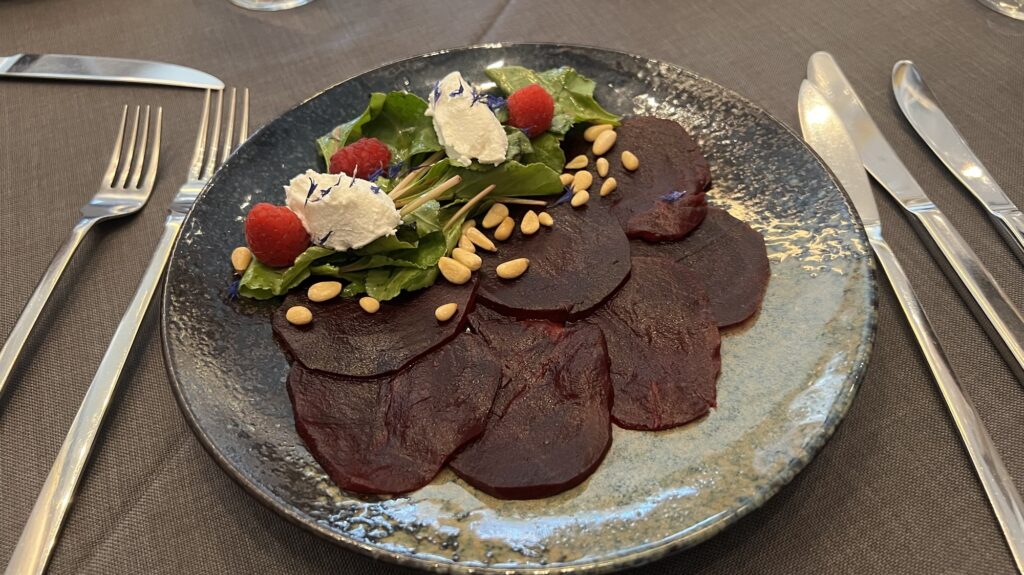
The beetroot carpaccio arrived first: paper-thin slices layered with raspberries, spinach, and cooked beets, crowned with “Goat Bonnie” whipped cream cheese and a scatter of cedar nuts. Simple yet complex. The flavors form a taste rainbow that shines through from the stomach to the mind and finally the soul. Today I am whole.
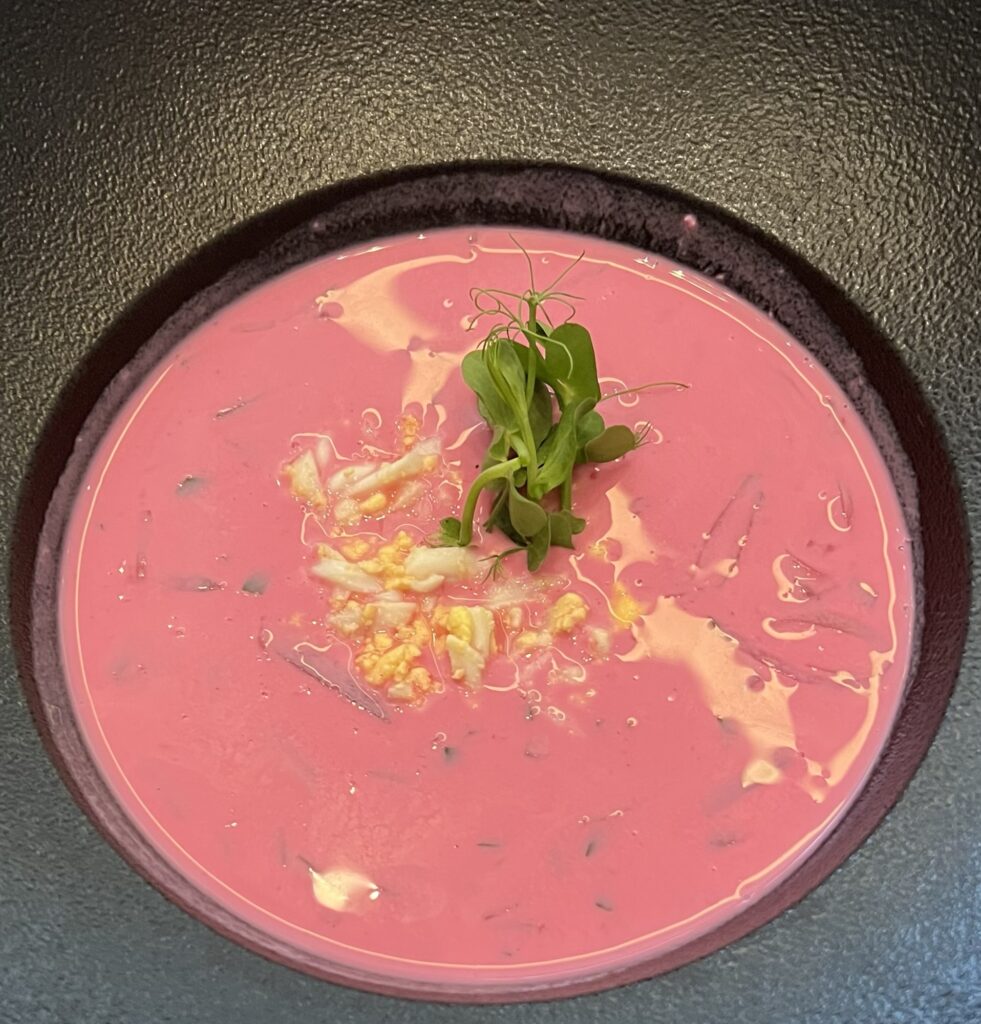
The cold beetroot soup followed — served ice cold, a shock in the best way. Two warm boiled potato wedges accompanied the chill, creating a beautiful contrast of soupy versus starchy. The potatoes carried the most pungent chives I have ever smelled and tasted. Heaven.
Between courses, we sipped a Pierre Zéro Signature Grenache from Chavin, France — a non-alcoholic wine. We were skeptical that “non-alcoholic wine” was code for grape juice, but this was genuinely fantastic: dry, with just a hint of sweetness, and structured enough to stand alongside dishes of this caliber.
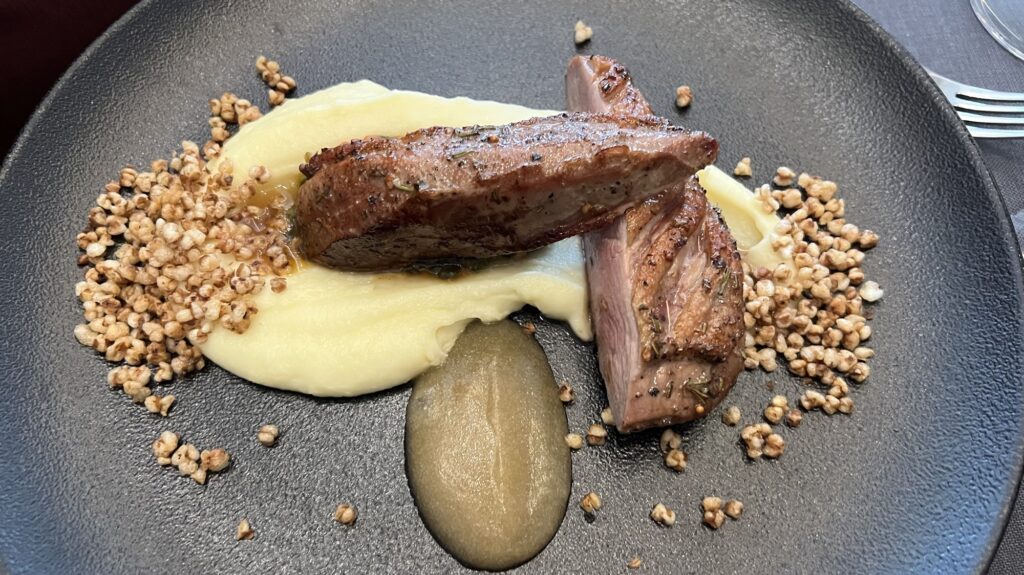
Mains arrived: duck breast with potato purée, warm tomato-spinach salad, apple jam, and buckwheat popcorn — the kind of dish where every component earns its place on the plate. And trout fillet that made me pause mid-bite. When I sliced into it, the flesh yielded like melting butter. This fish was so fresh it must have hitched a taxi ride from the ocean minutes before. The potato wedges held their own — farm-fresh, and I’d swear they came from a farm not far from here, grown by an elderly farmer named Alexi who knows exactly what his soil can do.

One note: the mostly American pop music blasting through the overhead speaker was the only thing out of place. This is a traditional Latvian restaurant of Michelin caliber — I would have preferred authentic Latvian music, opera, chamber music, or any variation. We encountered several accordion players while walking around Riga; perhaps they should be recruited to play here.
Because a Michelin star isn’t just about technique — it’s about ingredients that tell you where you are. Milda’s beetroot and trout don’t just taste of themselves; they taste of Latvia.
📊 By the Numbers
- Riga Central Market (free), spices €4
- Dumpling Corner Cafe omelet: casual market dining for two €20
- Riga Cathedral organ concert: included with cathedral entry €34
- Lasite lunch (Landlord’s Chicken + Grilled Chicken Plate): ~€46.50
- House of the Black Heads 10 each, €20
- Milda (★ Michelin 2026): multi-course tasting menu €107
- Steps walked: ~18,000
- Day total: ~€231.50
Riga Day 3: a day that opened with zeppelin-hangar strawberries, peaked with a Michelin beetroot that touched the soul, and closed with roast chicken in a dungeon. Riga, you’re showing off.
Leave a Reply