
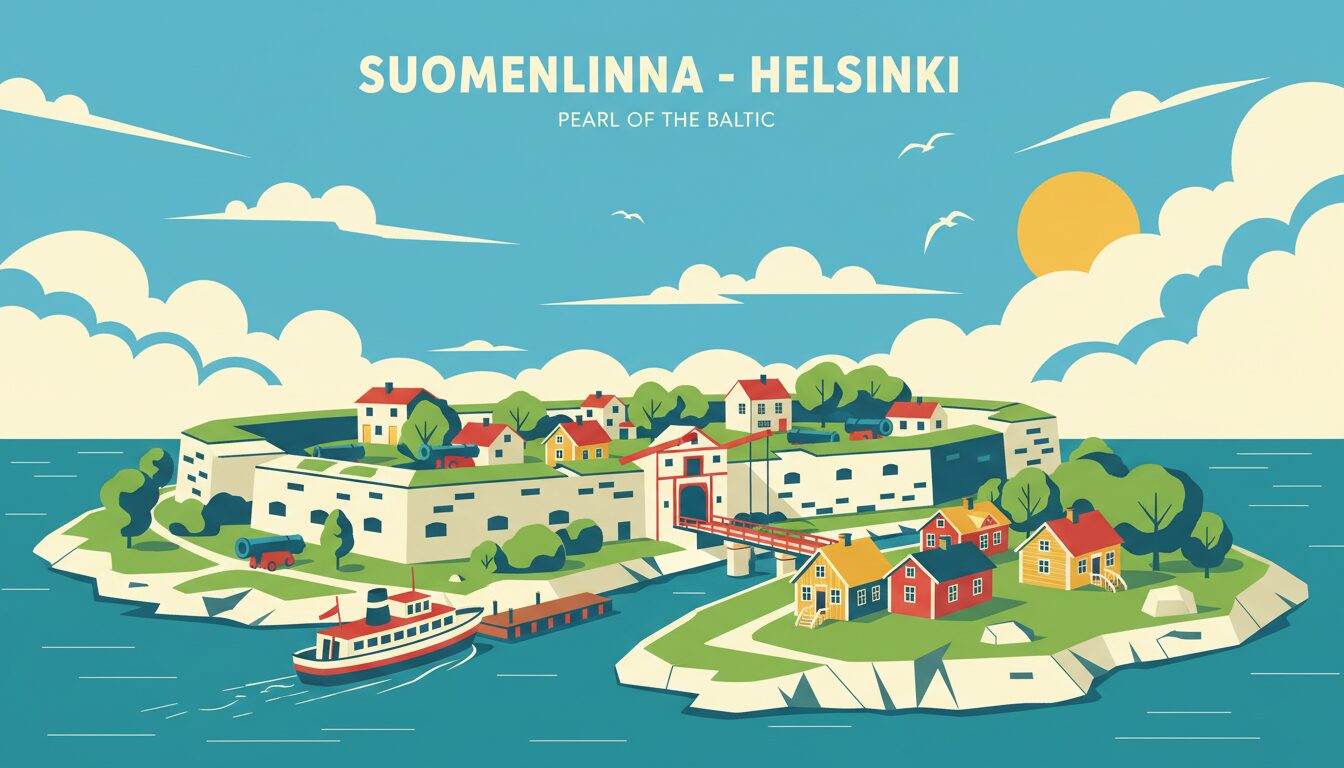
Six islands. Three centuries. One of the largest sea fortresses ever built — and a UNESCO World Heritage Site since 1991. Suomenlinna isn’t just a day trip from Helsinki. It’s a living neighbourhood, a military archive carved in granite, and a reminder that the Baltic has never been a quiet sea.
The Overview
Suomenlinna (known as Sveaborg in Swedish) was constructed beginning in 1748, when Finland was still part of the Kingdom of Sweden. The fortress was designed by Augustin Ehrensvärd to defend against Russian expansion — a strategic Gibraltar-of-the-North guarding the approach to Helsinki’s harbour. Over the following decades it grew into a massive complex of six interconnected islands: Kustaanmiekka, Susisaari, Iso Mustasaari, Pikku Mustasaari, Länsi-Mustasaari, and Långören.
It didn’t hold. In 1808, during the Finnish War, the fortress surrendered to Russian forces — a capitulation that still stirs debate among Finnish historians. Russia held it for over a century, adding barracks, an Orthodox church (later converted to Lutheran), and layers of imperial architecture. Finland inherited the fortress upon independence in 1917, renamed it Suomenlinna (“Castle of Finland”), and eventually turned it into the cultural landmark it is today.
UNESCO inscribed Suomenlinna in 1991 as “an outstanding example of 18th-century military architecture.” The citation notes its unique integration into the natural landscape — bastions that follow the contours of the bedrock, tunnels carved through granite, walls that seem to grow out of the sea itself. About 800 people still live on the islands year-round.
Practical Notes
- Guide: Official Suomenlinna Linktree — maps, museum hours, ferry schedules, restaurant info all in one place
- Ferry: HSL ferry from Kauppatori (Market Square) runs every 20-40 minutes, ~15 minute crossing. Standard HSL ticket (€4.80) covers the ferry. Alternative: FRS Finland ferry (€4.95/person).
- Entry: The island itself is free and always open. Individual museums charge admission (Suomenlinna Museum €10/adult).
- Walking: The main trail from the ferry dock to King’s Gate is about 1.5 km — wear comfortable shoes. The cobblestones and uneven granite are hard on ankles.
- Food: Several cafés and restaurants on the island. Picnicking on the ramparts is permitted and popular.
- Weather: Baltic winds can be sharp even in summer — bring a layer. There’s limited shelter on the open ramparts.
- Time: Allow at least 4-5 hours. A full day (6-8 hours) lets you see the museums, walk the full perimeter, and have a leisurely lunch.
👁 Vista — First Impressions
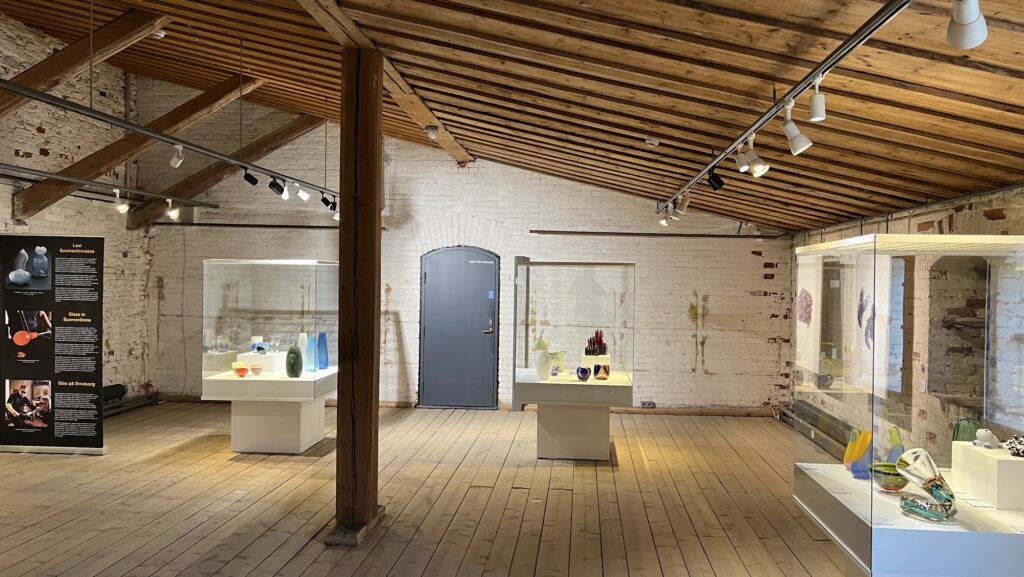
Inside the museum: hand-crafted and hand-blown glass art and sculpture — delicate objects born from fire and breath, displayed within walls built to withstand cannon fire. The contrast couldn’t be sharper. Glass that would shatter at a single musket ball, preserved inside a fortress designed to absorb an armada.
The canopy of heart-shaped linden leaves is visible from the moment you approach the dock — the pale yellow-green flowering bracts and blossoms catching the morning light throughout the crowns of these massive old trees. Their large, ancient trunks with burls and knobby growths speak to centuries of presence on this island. They frame the fortress walls, soften the military lines, remind you that nature was here first.
👃 Aroma — The Linden Trees and the Museum
The first thing that hits you stepping off the ferry isn’t the sea air or the granite — it’s the sweet, beautiful scent of flowers from the massive linden trees that line the island’s paths.
Heart-shaped leaves with finely serrated edges form the canopy. Pale yellow-green clusters throughout the crown are the flowering bracts and blossoms — the source of that strong, sweet fragrance that’s the hallmark of linden in early to midsummer. The flowers are famous for attracting bees, and the air hums with them.
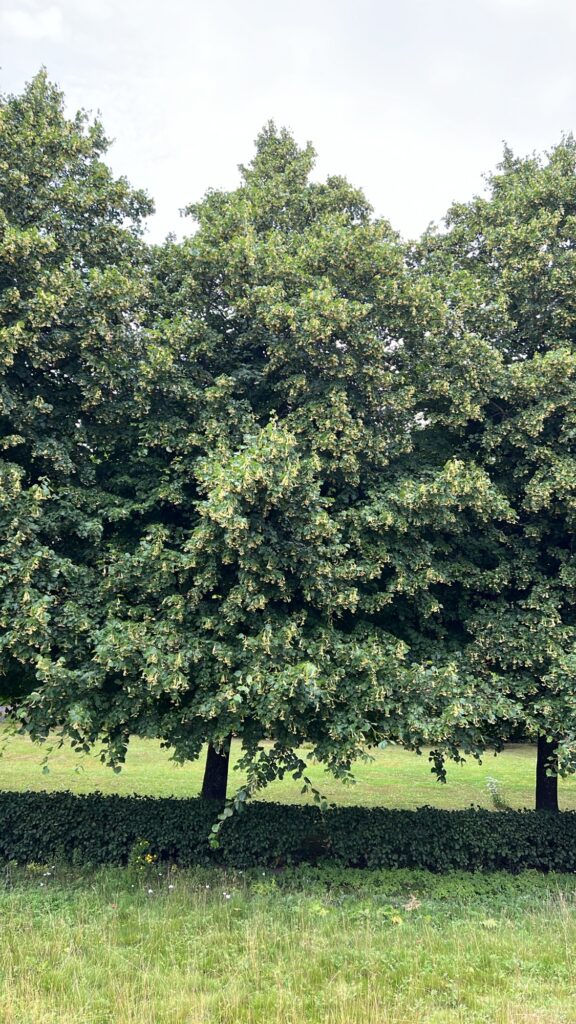
The trunks tell their own story: large, old, covered in burls and knobby growths — typical of mature lindens that have been pollarded or have grown for centuries. These trees were here long before most of the tourists. They’ve watched armies come and go.
Inside the Suomenlinna Museum, the air shifts. Rustic metals — the faint iron-and-oxidation scent of centuries-old cannons, tools, and anchors. Pine wood on the flooring and ceiling beams, that clean, resinous Nordic timber smell that grounds every Finnish interior. The two scents layer: metal from the fortress, pine from the land it was built on. And outside again, walking the ramparts toward King’s Gate: the scent of brine water in the air — salt, seaweed, the particular freshness of a cold northern sea — carried on a cool breeze that blows through your hair and reminds you this is still an island, still surrounded, still at the mercy of the Baltic.
Because sometimes a fortress’s first defence isn’t a wall — it’s a smell that stops you in your tracks and makes you forget, for a moment, why you came.
✋ Touch — The Digital Flipbook
The museum houses a digital flipbook tracing the island’s full history — a touchscreen chronicle that walks you through Swedish construction, Russian occupation, Finnish independence, and UNESCO recognition. Flicking through the pages with your fingertips, you feel the weight of 270 years compressed into gestures. It’s tactile history — swipe, pause, zoom in on an 18th-century map, trace the shoreline with your finger.
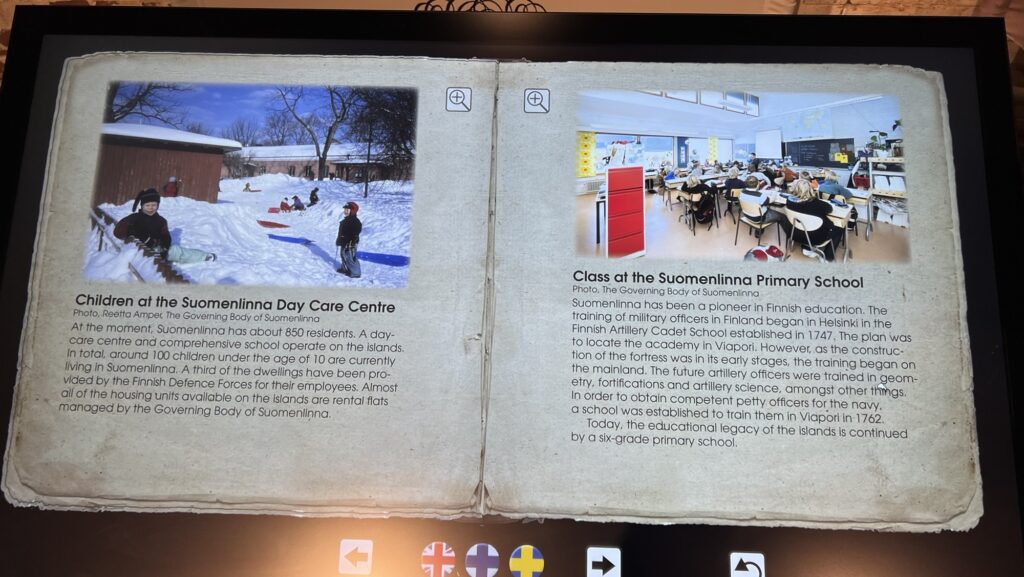
Because some histories need to be touched to be understood.
👂 Cadence — The Soundtrack of the Sea Fortress
Walking the mile-and-a-half from the museum to King’s Gate, the fortress slowly falls quiet. The visitor voices fade. What replaces them is older.
Birds chirping from the linden canopy. Seagulls gawing overhead, their cries carrying across the water. And underneath it all — the constant, patient slashing of waves against stone. The Baltic has been working on these ramparts for 270 years. You can hear it in every swell.
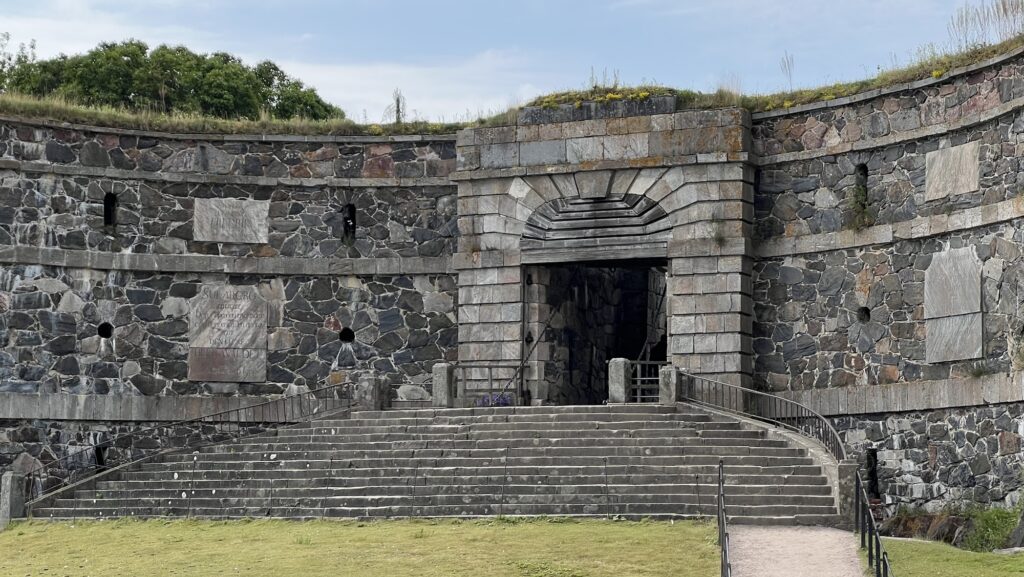
Waiting at King’s Gate for the ferry, the soundscape is complete: wings, water, wind. No engines. No announcements. Just the island breathing.
Because the best soundtrack on any island is the one that was playing long before you arrived.
🎵 Audio timepoint: 05bdd015-8263-457a-b2a9-ce5338783b59 — recorded July 18, 2026 at Suomenlinna King’s Gate.
🙏 Sanctuary — The Ghosts of Suomenlinna
Then the film.
A haunting documentary plays on loop — the wars fought over this archipelago: Sweden, Russia, France, Finland. Cannon fire. Naval blockades. The siege of 1808. The civil war of 1918. The Winter War and Continuation War. Decades of blood shed on and around these six small islands.
My soul feels sorrow for all the bloodshed. Sitting in the darkened screening room, surrounded by stone walls that absorbed the concussion of real artillery, I sense the ghosts of lost souls on this island. Not in a supernatural way — in the way that certain places hold memory in their stone. Suomenlinna was built to protect. It also buried. It also imprisoned. Those stories are here, just beneath the surface, waiting in the granite.
Because some fortresses protect more than borders — they protect the memory of what was lost, and the hope that we remember.
👅 Palate — La Galleria
Back on the mainland, we found lunch at La Galleria on Unioninkatu. Two tagliere di formaggi — wooden boards of Italian cheese, honey, and fruit paste — followed by a Parma pizza (prosciutto, arugula, parmesan shavings) and a classic Margherita. Lemonade and Coke Zero. €67 for three. Simple, honest, the kind of meal that doesn’t try to be anything more than it is — and succeeds because of it.
👅 Palate — Dragon Phoenix
Dinner was a gamble. We picked Dragon Phoenix on Pohjoinen Makasiinikatu specifically to scratch a spicy itch — the kind that builds across days of Nordic cuisine and demands satisfaction. Chinese food in Helsinki. Two starters, two mains, a drink. €49.30 for three, paid with card.
The verdict: the kitchen knew its craft, but the flavors had been toned down. You could taste the ghost of Sichuan peppercorn, the memory of chili oil — but they’d been dialed back, presumably to accommodate the famously milder Finnish palate. What should have been a flavor bomb landed as a polite suggestion. Respectable. Competent. But not the fire we came for.
Because sometimes the spiciest thing about a restaurant in Helsinki is the hope you walked in with.
👅 Palate — Jymy Jäätelö (Sweet Redemption)
One last stop. After the polite disappointment of Dragon Phoenix, we needed a victory — something that delivered exactly what it promised. Jymy Jäätelö answered with salted caramel ice cream. Rich, cold, the salt cutting through the sweet with precision. Not toned down. Not accommodating. Just exactly right.
Our last taste of Helsinki. Tomorrow: Tallinn.
Because some cities you leave with a sigh. Helsinki, we left with ice cream on our lips and three days of stories in our pockets.
Day 3 By the Numbers
- ⛴️ HSL Ferry to Suomenlinna: €4.80
- 🏛️ Suomenlinna Museum (×2): €20
- ⛴️ FRS Ferry return (×2): €9.90
- 🍕 La Galleria lunch (×3): €67
- 🚗 Uber to laundromat: €10
- 🧺 Laundry (wash + dry ×2): €23.60 (cash)
- 🥡 Dragon Phoenix dinner: €49.30
- 🍦 Jymy Jäätelö ice cream: ~$8.93
- Day total: ~€184.60
🧭 Wander — King’s Gate and the Ferry Home
King’s Gate is the ceremonial entrance to Suomenlinna, built in 1753–54 — a double drawbridge spanning the water, crowned with a marble plaque where King Adolf Frederick of Sweden once stood. Ehrensvärd’s tomb rests nearby. It felt right to end the day here, at the threshold between fortress and sea.
The ferry approached. Lindens rustled. Gulls circled. The Baltic slapped its ancient rhythm against the bastion walls. A cool breeze moved through our hair, carrying brine and the faint echo of linden blossom. Suomenlinna gave us history and linden blossoms and ghosts. The mainland gave us pizza and polite Chinese food. Three centuries of military history on six small islands, and in the end the thing we’ll remember most is the silence between the waves. Tomorrow we sail for Tallinn. Helsinki has been three days of cathedrals, canvas, gelato, gardens, fortresses, and ice cream. We leave with sore feet and full hearts.
Because Suomenlinna was built to keep people out — and somehow, 270 years later, it makes you feel like you belong.
Leave a Reply