
Draft — sensory notes and photos coming after our July 2026 visit to Tallinn.
The Overview
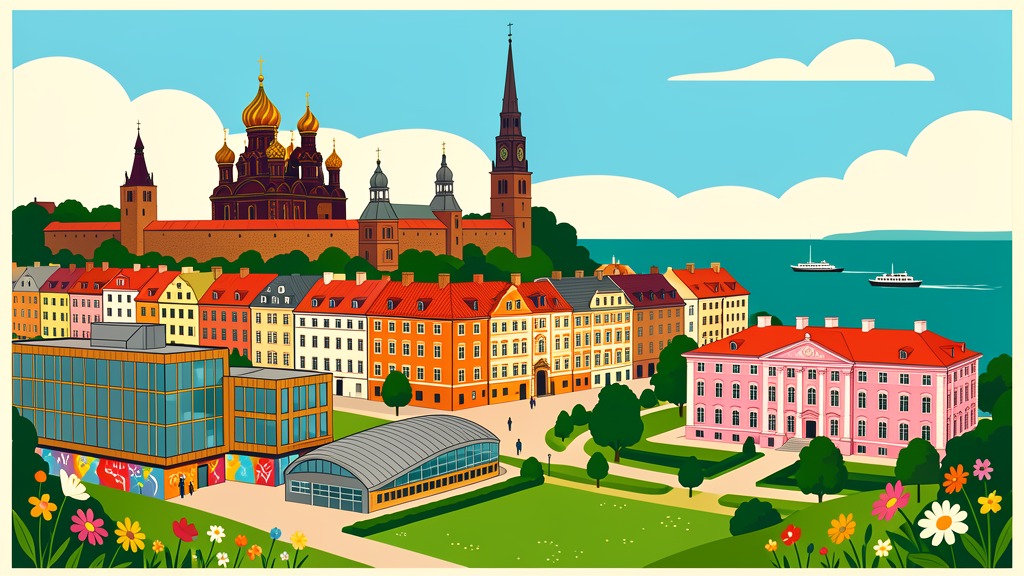
Tallinn is a city that wears its eight centuries lightly. The Old Town — a UNESCO World Heritage warren of cobblestone streets, Gothic spires, and merchant houses painted in pastels — is one of Europe’s best-preserved medieval cores. But Tallinn is not a museum piece. A fifteen-minute walk from Town Hall Square, Telliskivi Creative City hums with street art, third-wave coffee, and start-ups that built Skype and Wise. Estonia is the world’s most digitally advanced society, and its capital feels like a fairy tale that learned to code.
We arrive by ferry from Helsinki — two hours across the Gulf of Finland — and step into a city where medieval watchtowers cast shadows on craft breweries, where onion-dome cathedrals sit blocks from Soviet brutalist concert halls, and where the national art museum is a limestone wedge cut into a cliff. Three days. Seven senses. A city that has been Danish, Swedish, German, Russian, and Soviet — and emerged unmistakably Estonian.
👁 Vista — What We Hope to See
[Sensory notes to be added after the visit.]
- Toompea Hill — the upper town, crowned by the onion domes of Alexander Nevsky Cathedral and the pink baroque Toompea Castle (now Estonia’s parliament). From the Kohtuotsa viewing platform: what does eight centuries of red rooftops look like in the low Baltic summer light?
- Town Hall Square (Raekoja plats) — the heart of the Lower Town since the 13th century. The Gothic Town Hall with its dragon-head gargoyles, the pastel façades of merchant houses, the cobblestones worn smooth by eight hundred years of trade. At noon: does the square feel like a film set or a living city?
- Kumu Art Museum — Estonia’s national gallery, a limestone-and-glass wedge built into a limestone cliff in Kadriorg Park. Soviet-era Estonian art, contemporary installations, and a building that makes the landscape part of the exhibition. How does a nation that spent fifty years behind the Iron Curtain curate its own story?
- Kadriorg Palace — Peter the Great’s baroque summer palace, built in 1718 for Catherine I. Pink façade, formal gardens, swan pond. A pocket of tsarist Russia preserved in the Baltic forest.
- St. Olaf’s Church — once the tallest building in the world (1549–1625). The spire is a lightning rod for Tallinn’s skyline. The climb to the viewing platform: 258 steps. The view: worth every one?
- Seaplane Harbour (Lennusadam) — a 1916 concrete seaplane hangar housing a 1930s submarine, icebreaker, and maritime museum. Soviet hardware under soaring domes. Does the engineering outshine the exhibits?
Because a medieval city asks you to look up — but Tallinn asks you to look forward, too.
👅 Palate — What We Hope to Taste
[Sensory notes to be added after the visit.]
- NOA Chef’s Hall — one Michelin star, perched on the Gulf of Finland coast with floor-to-ceiling sea views. Chef Tõnis Siigur’s tasting menu runs through Baltic Sea and forest produce. Does a Michelin plate taste different when the sea is literally at your window?
- 180 Degrees by Matthias Diether — one Michelin star, hidden in a courtyard in the Old Town. An open kitchen, a Chef’s Table format, and a tasting menu that moves through Estonia’s seasons. Sixteen seats. That kind of evening.
- Rataskaevu 16 — the most beloved restaurant in Tallinn’s Old Town, and not Michelin-starred. Estonian comfort food — elk, forest mushrooms, rye bread — served in a 15th-century building with wood-beam ceilings. The reservation you make before you book your flight.
- Leib Resto ja Aed — “Black Bread” in a secret garden courtyard. Seasonal Estonian cooking that feels like eating in a friend’s backyard, if your friend were a genius with Baltic ingredients.
- F-Hoone — the flagship restaurant of Telliskivi Creative City, set in a former Soviet-era factory. Industrial, unpretentious, buzzing. The sort of place that defines a neighborhood’s energy. What does the Telliskivi crowd taste like?
- Balti Jaam Market — the old train station market, now a three-story food hall. The oyster bar next to the pelmeni counter. Soviet nostalgia meets Nordic foodie, and somehow it works.
Because Estonia’s table tells the story of every country that ever sat at it.
👂 Cadence — What We Hope to Hear
[Sensory notes to be added after the visit.]
- The bells of Tallinn — St. Olaf’s, St. Nicholas’, the Holy Spirit Church. A medieval city runs on bells. Do they still ring on the quarter-hour, and does anyone still set their watch by them?
- Estonian Song Festival grounds (Lauluväljak) — the amphitheater that holds 100,000 singers for the quinquennial Song Festival that defined Estonia’s Singing Revolution. We’ll miss the festival by a year, but does the empty stage still hum?
- Telliskivi at dusk — street musicians, café chatter, the clink of craft beer glasses in a converted factory. The sound of the new Estonia.
- The silence of Toompea after the day-trippers leave — when the cruise ships depart and the upper town empties. Cobblestone silence. A different city after 5 PM.
Because Estonia sang itself free — and the echo still lingers.
👃 Aroma — What We Hope to Smell
[Sensory notes to be added after the visit.]
- Rye bread — the smell of Estonia’s national staple, dark and slightly sour. The bakeries of the Old Town at dawn: does rye perfume the cobblestones?
- Kadriorg Park — pine forest, formal rose gardens, the sea air drifting up from Pirita. A baroque palace wrapped in Baltic woodland. What does Peter the Great’s summer retreat smell like in July?
- Balti Jaam Market — smoked fish, fresh dill, pickled everything, roasting meat. Three stories of Estonian food culture in a converted train station. The nose leads, the stomach follows.
- Sea salt at Lennusadam — the maritime museum inside a concrete seaplane hangar still smells faintly of the Baltic. Old submarines and salt air. Does history have a scent?
Because some cities announce themselves before you ever open your eyes.
✋ Unwind — What We Hope to Feel
[Sensory notes to be added after the visit.]
- Telliskivi sauna — Estonia’s sauna culture runs as deep as Finland’s. The creative district has its own. Hot stones, cold beer, brick walls. Can a former factory become a sanctuary?
- The cobblestones of the Old Town — worn to a polish by eight centuries of boots, hooves, and wheels. Uneven. Slippery when wet. What does a medieval street feel like underfoot at midnight in July, when it’s still light?
- The Seaplane Harbour submarine (EML Lembit) — a 1936 Estonian submarine you can climb inside. Narrow corridors, brass dials, the feel of diesel-era engineering. Claustrophobic. Alive with history.
- Kadriorg Park benches — the quiet ritual of sitting still in a baroque garden, watching swans. Because a trip needs empty space as much as it needs sights.
Because the body remembers what the camera forgets.
🙏 Sanctuary — What We Hope to Feel in the Spirit
[Sensory notes to be added after the visit.]
- Alexander Nevsky Cathedral — Russian Orthodox, built in 1900 when Estonia was a tsarist province. Eleven bells, gold icons, the smell of incense. The most beautiful building in Tallinn, and also the most politically charged. Does a place of worship transcend the empire that built it?
- St. Nicholas’ Church (Niguliste) — now a museum and concert hall rather than an active church, but still sacred. The surviving fragment of Bernt Notke’s Danse Macabre — death leading all estates, rich and poor alike. A 15th-century reminder in a digital-first nation.
- The city walls at twilight — walking the intact medieval fortifications when the day-trippers have gone. Twenty-six watchtowers still standing. What does it feel like to walk the perimeter of a city that has survived Danish kings, Teutonic knights, Swedish empire-builders, Russian tsars, Soviet occupiers, and emerged free?
Because the walls that protected Tallinn are still standing — and so is Tallinn.
🧭 Wander — What Drew Us Here
[Sensory notes to be added after the visit.]
- Why Tallinn? Because the Baltics are the least-traveled corner of Europe, and Tallinn is the gateway. Because a two-hour ferry from Helsinki lands you in a different century — and a different empire’s shadow. Because Estonia’s story — occupied for fifty years, independent for thirty, digital leader of Europe — is one of the great under-told narratives of the continent.
- The serendipity of the Old Town’s back alleys — away from Town Hall Square, away from the tour groups. A courtyard café, a craftsman’s workshop, a cat sleeping on a medieval windowsill. The best street in Tallinn is the one you find by getting lost.
- Kalamaja — the “Fish House” district, Tallinn’s old fishermen’s quarter, now a maze of colorful wooden houses and hipster cafés. A neighborhood that gentrified without losing its soul. What does it feel like to walk streets where the wooden architecture is older than most countries?
- What we didn’t plan for — a concert we didn’t book, a meal we stumbled into, a conversation with a stranger. The best moment in Tallinn will be the one not on this page.
Because travel reduced to sightseeing is travel half-lived.
Practical Notes
- Getting there: Ferry from Helsinki — Tallink Silja or Viking Line, 2 hours across the Gulf of Finland. Walk-up tickets ~€25–40. Book ahead in summer. The ferry terminal is a 10-minute walk from the Old Town.
- Hotel: Hotel Telegraaf, Autograph Collection (Marriott Bonvoy). 19th-century former telegraph exchange in the heart of the Old Town, steps from Town Hall Square. Platinum elite benefits apply.
- Getting around: The Old Town is entirely walkable. For Kadriorg, Kalamaja, and Telliskivi, use the Bolt app (Estonia’s own Uber competitor — faster and cheaper, and you’re supporting local). Tallinn also has an excellent tram network.
- Old Town vs. New Town: Spend one full day in the Old Town, then escape. The real Tallinn lives in Kalamaja, Telliskivi, and Kadriorg. Tourists who never leave the walls miss the country.
- Dining reservations: NOA Chef’s Hall and 180 Degrees book 4–6 weeks out for weekends. Rataskaevu 16 books 2–3 weeks out — reserve as soon as your dates are firm.
- Museums: Kumu is closed Tuesdays. The Tallinn Card covers entry to 40+ museums including Kumu, Seaplane Harbour, and Kadriorg Palace. 24hr card: €38.
- Language: Estonian is a Finno-Ugric language — unintelligible to nearly everyone who isn’t Estonian. English is widely spoken, especially among under-40s. “Tere” (hello) and “Aitäh” (thank you) will earn you smiles.
- Digital Estonia: Free public Wi-Fi is everywhere — Estonia declared internet access a human right in 2000. You can pay for parking with your phone, vote online, and sign legal documents with your digital ID. The future arrived here first.
- Currency: Euro (€). Cards accepted everywhere. You may literally never see physical Estonian currency.
- Weather in July: Average highs 21°C (70°F), lows 12°C (54°F). The Old Town cobblestones are uneven — wear comfortable shoes. Rain is possible any day.
Leave a Reply