
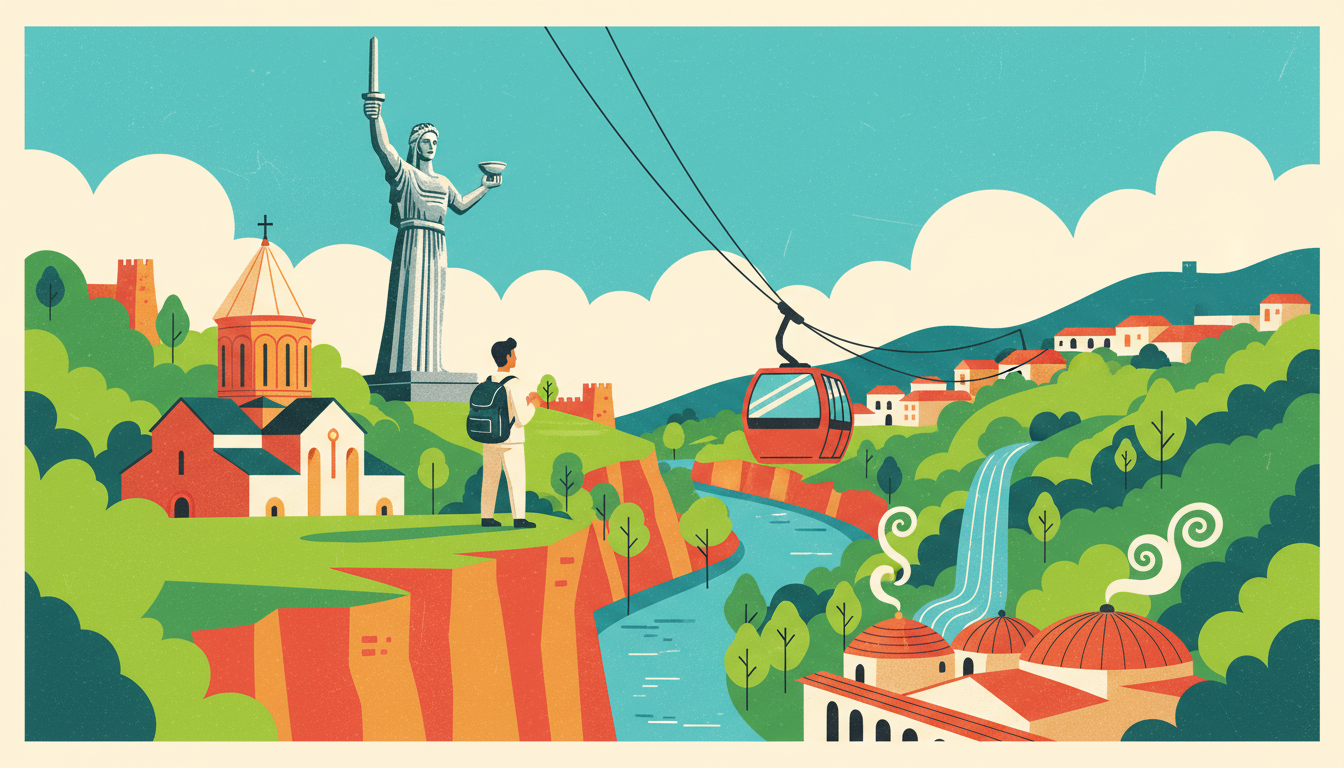
Breakfast of champions at Santino. I ordered an egg omelet — tasty but I couldn’t finish it. Two cups of coffee instead, because I had a long day planned and needed the fuel more than the food. The kind of morning where caffeine is reconnaissance: mapping out the hours ahead while the city wakes up around you.
🧭 Wander — The Fortunate Mistake
I hopped on my first Tbilisi bus, metro card in hand, feeling the small satisfaction of having figured out the transit system on Day 1. Then I overshot my stop by one. A rookie error — or so I thought. The mistake deposited me at a vantage point where I could photograph Narikala Fortress on the ridge and the Mother of Georgia statue silhouetted against the morning sky. The shot was perfect. The kind you don’t get from the intended stop. I’ve learned, over years of travel, that the best photographs come from being slightly lost. Not lost-lost — just off-script enough that the itinerary hasn’t already framed the view for you.
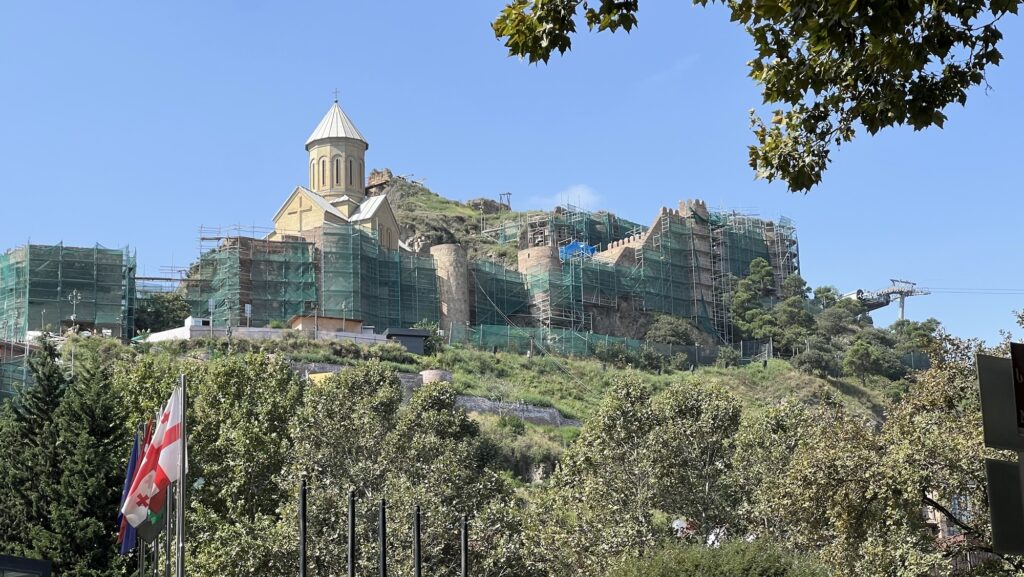
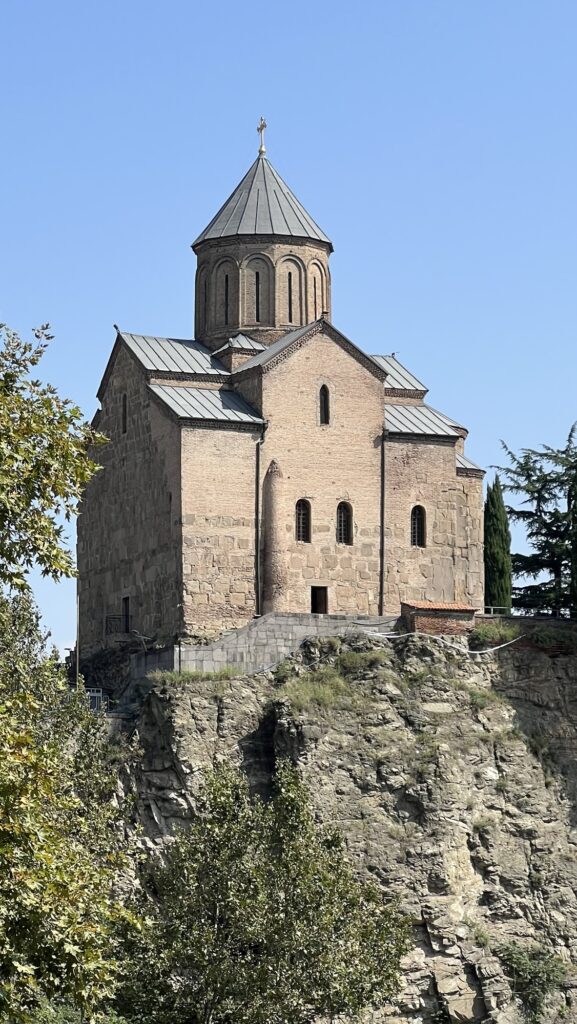
From there, I walked to Metekhi Church of the Nativity of the Mother of God, perched on a rocky cliff above the Mtkvari River. The original church was built in the 13th century by King Demetre II, though the site itself is far older — this cliff has held a church since at least the 5th century, when it was associated with the martyrdom of Saint Shushanik, a Georgian noblewoman tortured and killed by her Zoroastrian husband for refusing to renounce Christianity. In front of the church stands an equestrian statue of King Vakhtang Gorgasali, the 5th-century founder of Tbilisi, looking out over the city he named after its warm sulfur springs. The church, the king, the river below — it’s all there in one frame, Georgia’s origin story in stone and bronze.
👁 Vista — The Gondola and the Mother of Georgia
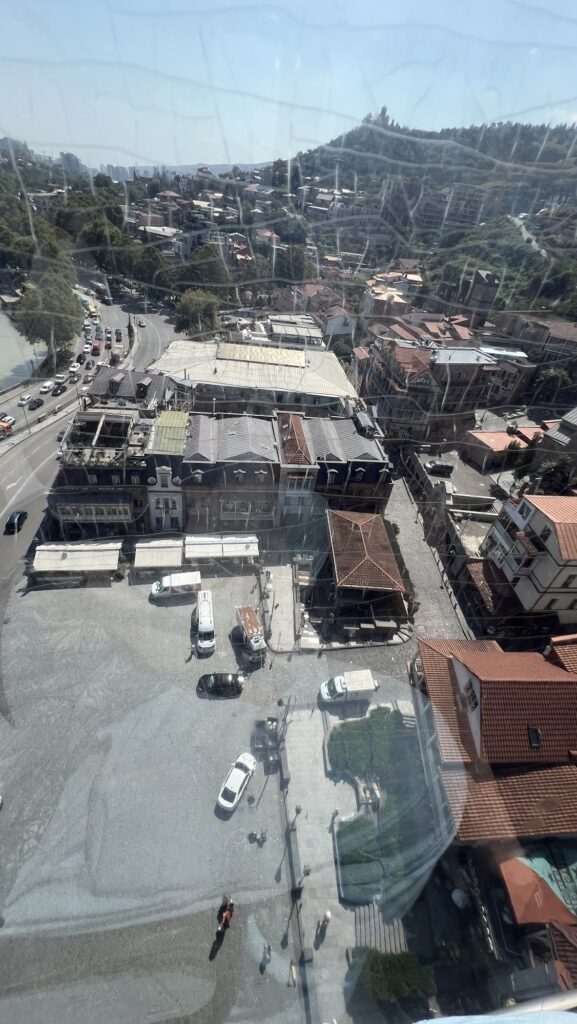
After the church, I headed to the gondola station. Here’s a small but crucial piece of Tbilisi transit wisdom: there are two kinds of metro cards. The blue card works for buses and the metro. The white card works for buses, metro, and the gondola. I had the white one. Unprepared travelers were caught in a queue, fumbling for change, buying single tickets — I breezed through as the attendant winked and waved me past. If you’re going to Tbilisi, get the white card. I paid and loaded 50 GEL for mine on Day 1 and it’s already paying dividends in seconds saved and small private moments of superiority.

The Tbilisi gondola opened in 2012, a sleek modern cable car that runs 600 meters from Rike Park on the riverbank up to the Narikala Fortress ridge. The ride takes about two minutes, but in those two minutes the entire city unfolds beneath you — the Mtkvari winding through Old Tbilisi’s carved balconies, the dome of the Sameba Cathedral in the distance, the cube-like Parliament building, the patchwork of red-tiled roofs and Soviet apartment blocks and new glass towers. It’s the best €2 view in the Caucasus.
At the top: Kartlis Deda, the Mother of Georgia. A twenty-meter aluminum statue by sculptor Elguja Amashukeli, erected in 1958 to mark Tbilisi’s 1,500th anniversary. She holds a sword in her right hand for enemies and a wine bowl in her left for friends. It’s a piece of Soviet-era monumentalism, but the symbolism is pure Georgian — the sword says we have survived everyone who tried to conquer us, and the wine bowl says and we will still pour you a drink when you arrive in peace. I stood at her feet and looked out over Tbilisi, taking in the whole city from my perch. Churches. Bridges. Bathhouse domes. The botanical gardens spilling green down the gorge behind me. A city that has been burned and rebuilt so many times it no longer remembers how to stay down.
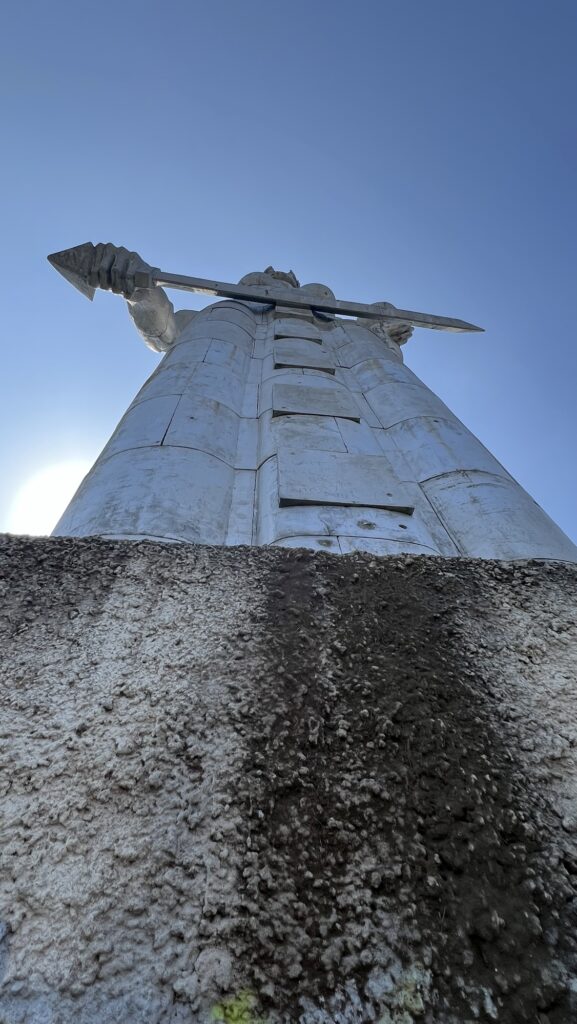
👁👃 Vista & Aroma — National Botanical Garden
From the statue, it’s a short walk to the upper entrance of the National Botanical Garden of Georgia (4 GEL). The garden occupies 161 hectares of the Tsavkisistskali River gorge, tucked behind Narikala Fortress. It was founded in 1845 and now holds over 3,500 species. But none of that registers when you first step through the gate. What registers is the smell — pine, damp earth, running water. The air changes here. It’s cooler, thicker, alive.

I started down the stair path, descending into the gorge. The sound of rushing water was constant — there are waterfalls here, real ones, not garden-center trickles. I reached the main waterfall platform and stood there for a while, letting the mist hit my face while a handful of other visitors came and went. The gardens were quiet. Deeply, almost impossibly quiet for a capital city. Just the water, the birds, and the occasional rustle of bamboo.
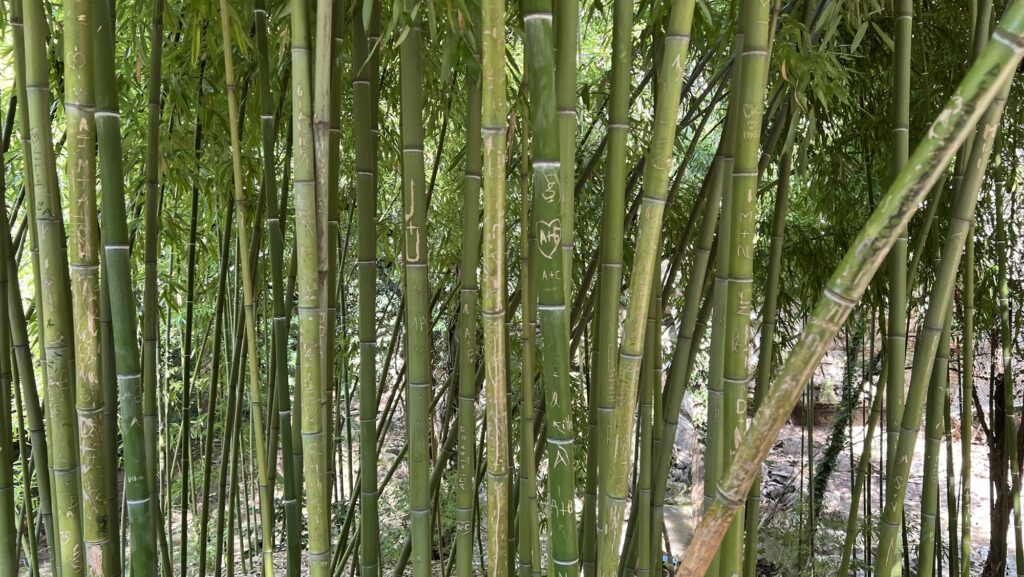
Yes — bamboo. Further down the path, a bamboo forest rises on both sides, the stalks thick and tall, filtering the light into green stripes. It’s disorienting in the best way: you’re in a bamboo grove that feels like southern China or northern Thailand, but you’re ten minutes from a 13th-century Georgian Orthodox church and a gondola station. I kept going, found another waterfall — smaller, less dramatic than the first but still worth the walk — and then turned back. Many paths were closed: falling rocks, disrepair, the quiet neglect of a garden that deserves better funding. It’s a lovely place, and I hope Georgia invests in it. A botanical garden in a river gorge behind a medieval fortress should be one of the great urban parks of the world. It’s close. It just needs some love.
The descent through the garden is essentially a hike through the mountain — a steady downhill that takes you from the Narikala ridge all the way to the Abanotubani bath district. I emerged from the greenery into the smell of sulfur.
✋ Unwind — Chreli Abano Sulfur Baths
I ended up at Chreli Abano, one of the more modern bathhouses in the Abanotubani district. The cost: 213 GEL for a private room rental, towel, and scrub glove. The scrub and massage are an additional 35 GEL. 248 GEL total (≈ €84). Not cheap by Tbilisi standards, but I was pressed for time and paid the premium. The cheaper rooms — shared, smaller, less private — were available, but after a long morning of walking and hiking down a mountain gorge, I wanted solitude and space.
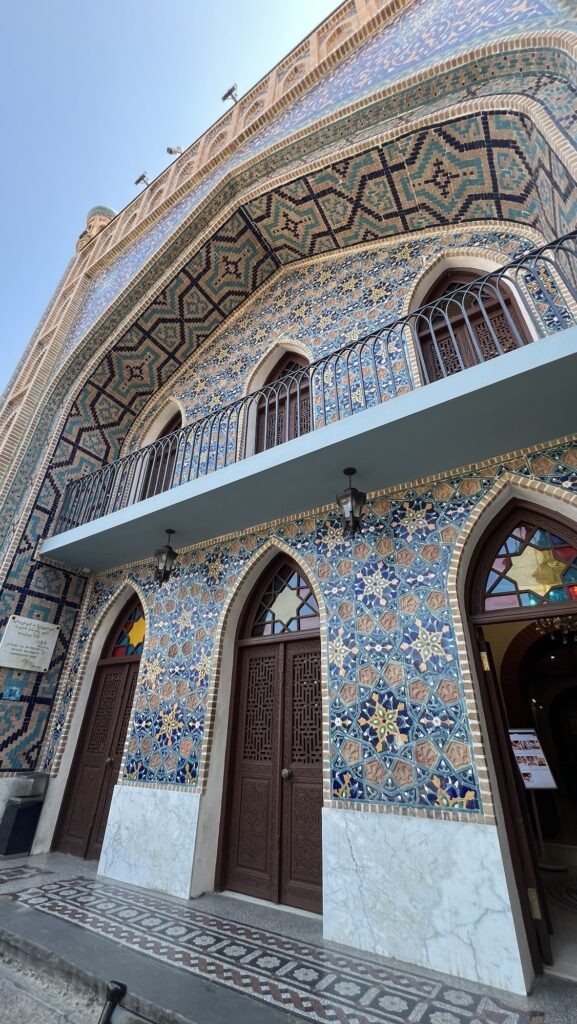
The water is called sulfur water because it is infused with sulfur — and it earns the name. The odor is pungent, not subtle. You smell it before you see it. The temperature: 45 degrees Celsius (113°F). The attendant told me to soak for no more than 15 minutes, then take a cold shower. I have done hot springs before — New Zealand, Iceland — and thought I could handle it. After five minutes, I had to get out and cool down. Five minutes. The heat penetrates in a way that geothermal pools don’t — the sulfur, the confined space, the steam, all combining into something that feels like it’s working on your bones rather than your skin.

I repeated the cycle — in, out, cold shower — for about 30 minutes. Then the scrub and massage team came in. The scrub was, to be honest, a bit brutal. The attendant uses a rough mitt called a kisa and removes what I will charitably describe as a top layer of your existence. Dead skin, yes, but also whatever illusions you had about being adequately exfoliated. It is thorough. It is not gentle. When it was over and I looked at the marble slab, I understood why they don’t do this in a public room.
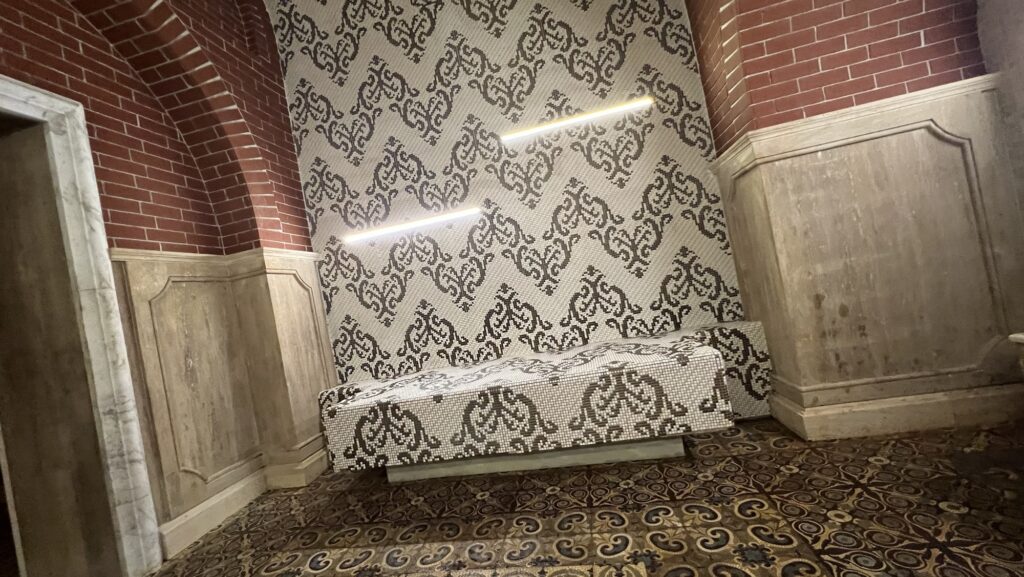
The massage was gentler — essentially a soap-soaked puffy towel rubbed onto shoulders, back, and legs. More foam than force. After the scrub, it felt like an apology.
But here’s the thing: after leaving the bathhouse, I did feel renewed. Refreshed. Like something heavy had been stripped away — not just skin, but a layer of accumulated tension from two months of walking across Europe. The sulfur bath is an experience worth the money. If I do it again, I’ll skip the scrub and massage and just soak in the private room. The water does the work. Everything else is commentary.
By the Numbers
| Item | Local | EUR |
|---|---|---|
| Santino — egg omelet, 2 coffees | 38 GEL | ≈ € 12.67 |
| Bus — metro card swipe | 1 GEL | ≈ €0.34 |
| Gondola — metro card swipe (white card) | 2 GEL | ≈ €0.68 |
| National Botanical Garden — admission | 4 GEL | ≈ €1.36 |
| Gondola return — metro card swipe | 2 GEL | ≈ €0.68 |
| Chreli Abano — private room, towel, scrub glove | 213 GEL | ≈ €72.42 |
| Chreli Abano — scrub & massage add-on | 35 GEL | ≈ €11.90 |
| Day Total | 257+ GEL | ≈ €99.67 |
A wrong bus stop that delivered the perfect photograph. A white metro card that parted the gondola queue like a diplomatic passport. A botanical garden in a river gorge that deserves to be world-famous. And a sulfur bath so hot it humbled a man who thought New Zealand had prepared him for anything. Tbilisi Day 3 — for about the price of a single Broadway ticket in New York. Georgia continues to deliver.
Leave a Reply